Post 10 min read
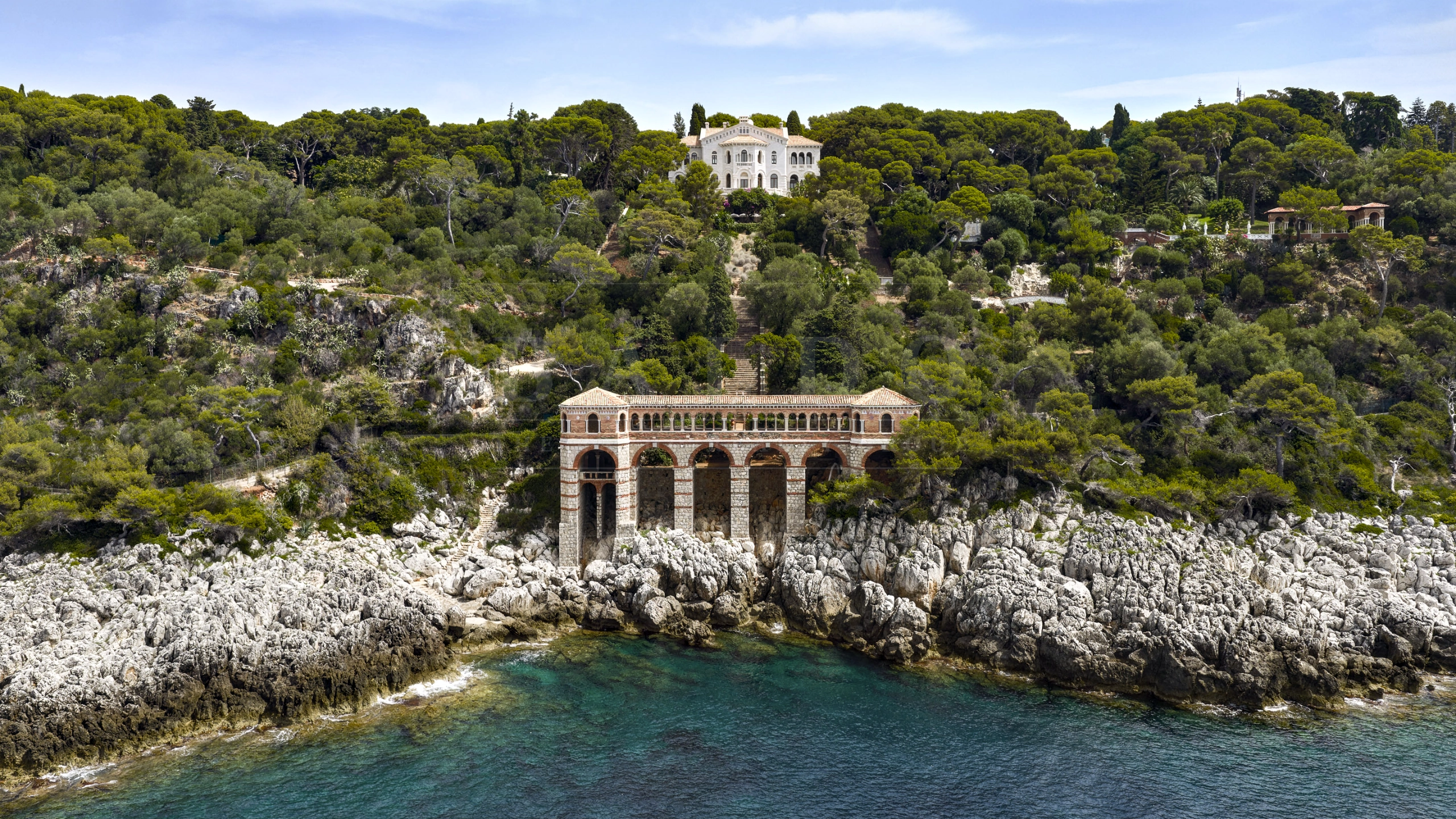
In January 1923, the photographer Roger Dumas brought his camera and glass plates to Cap Martin. He was working for the banker Albert Kahn, whose Archives de la Planète set out to record the world in colour. One of his autochromes shows a Byzantine gallery on the rocks, its arches open to the sea. In another, a woman in her sixties appears among the columns of her garden.
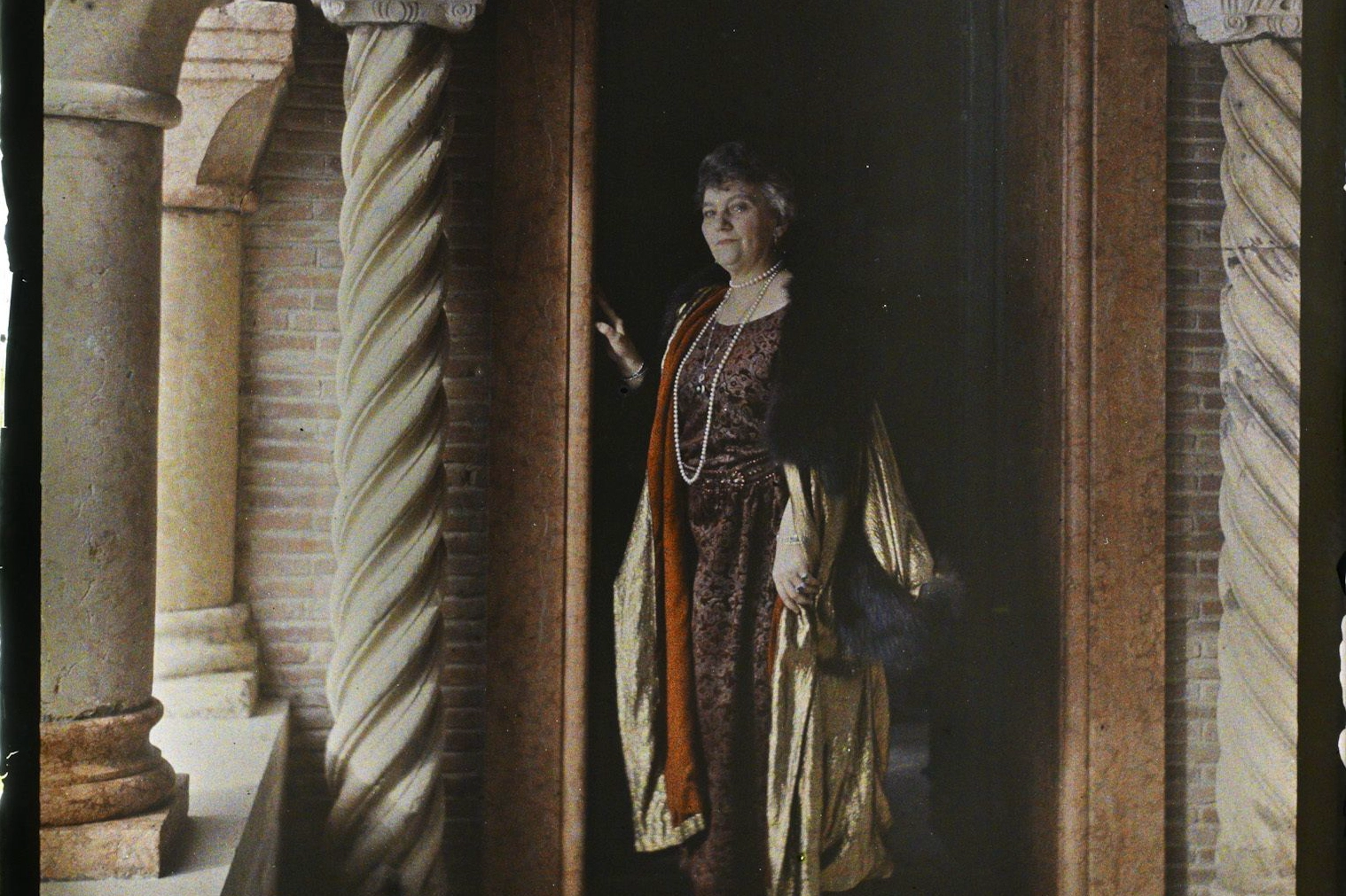
Cyprienne Douine among the spiral columns of Villa Cypris, 1923. Credit: Roger Dumas, Département des Hauts-de-Seine, musée départemental Albert-Kahn, Archives de la Planète
She was Cyprienne Douine, and the house above her was Villa Cypris. Its story begins at the corset counter of a Paris department store. From there it runs as far as an Olympic regatta, by way of two empresses and a schooner built for the Kaiser. Today the house, its garden and its gallery share a single heritage protection, which reaches every stair, column and path between the gates and the shore.
Cyprienne was born Anne Marie Dubernet in 1857, the daughter of a wool spinner in Lot-et-Garonne. As a young woman she sold corsets at the Grands Magasins du Louvre, one of the great Paris department stores. Its director and owner, Olympe Hériot, was almost a quarter of a century older. By the time they married in 1887 they already had two children, and two more followed.
Émile Zola had published a version of this story four years earlier. In Au Bonheur des Dames, a young shop assistant wins the heart of the man who owns the store, and the novel closes on his proposal. For Cyprienne, the wedding was only the opening chapter.
Olympe Hériot died in 1899 and left her the bulk of his fortune. She spent it with conviction. In 1903 she engaged Hans-Georg Tersling, the Danish architect of the Grand Hôtel du Cap-Martin, to build her a mansion on the Rue de la Faisanderie in Paris. The following year she bought Katoomba, a large steam yacht she later renamed Salvador.
Between April and June 1904, her daughter Virginie, not yet fourteen, made her first cruise on board with her brother and seven family friends. The yacht worked its way from Naples and Syracuse to Constantinople. Along the way the girl met Pierre Loti, the novelist and naval officer, who welcomed her aboard the Vautour, the warship he commanded. She came home sure that she would become a sailor. Cyprienne, for her part, turned the voyages into a book, Croisière en Méditerranée, published in 1905.
Cap Martin’s own transformation had begun two years after her wedding. Until then the cape was a hunting estate that had changed hands several times. In March 1889, a wealthy Briton named Calvin White bought it for 575,000 gold francs and set about turning it into a winter resort.
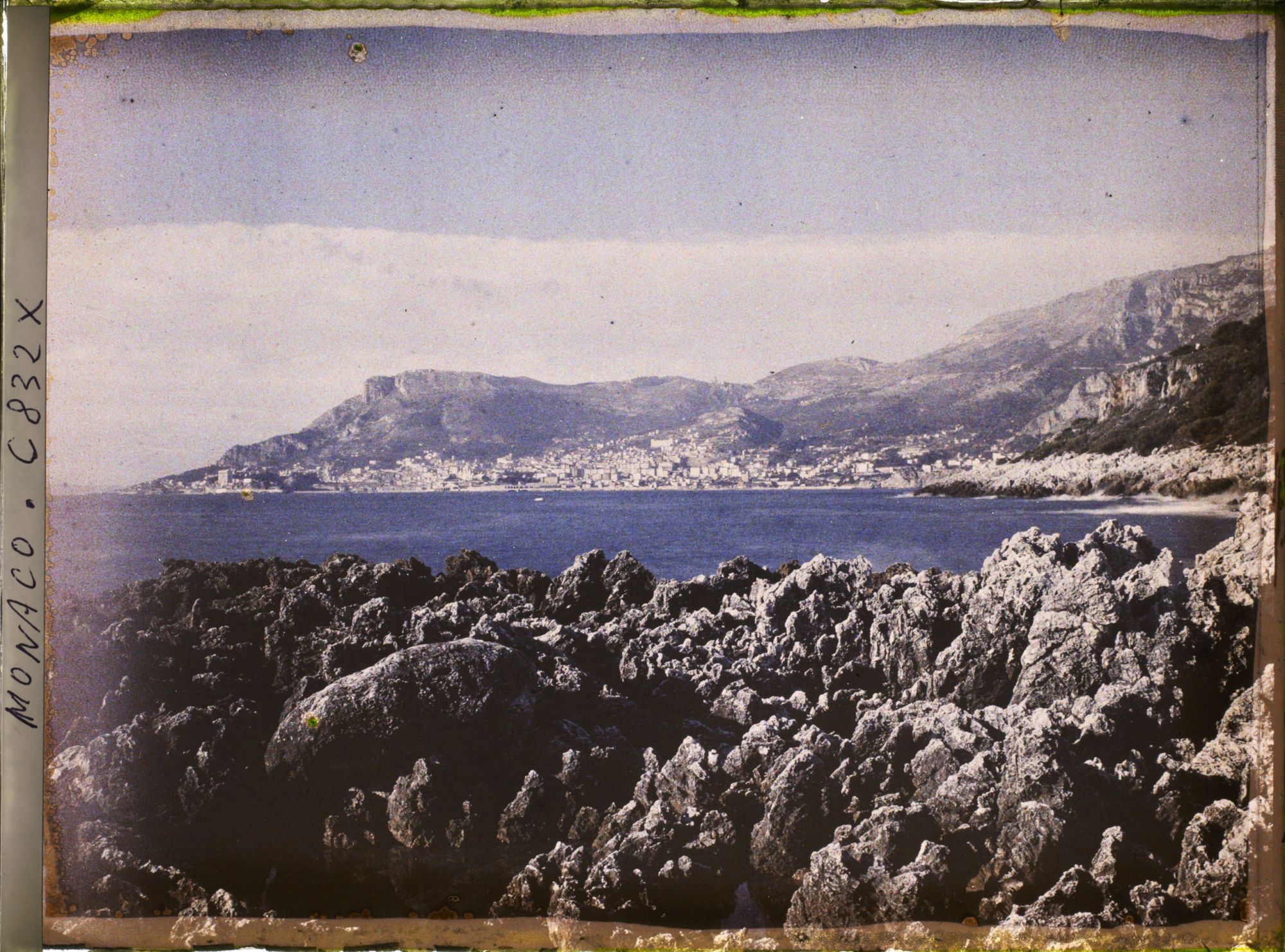
The rocks of Cap Martin, with Monaco across the bay. Credit: Département des Hauts-de-Seine, musée départemental Albert-Kahn, Archives de la Planète
His architect was Tersling. Work on the Grand Hôtel du Cap-Martin began at the tip of the cape in 1890, and the first phase was complete by 1891. Its long west wing soon held the suites of Emperor Franz Joseph of Austria and Empress Elisabeth, who wintered there through much of the decade. Admirers later raised a Tersling obelisk on the cape in her honour. Its inscription recalls her evenings among the rocks, breathing in the scent of wild mastic.
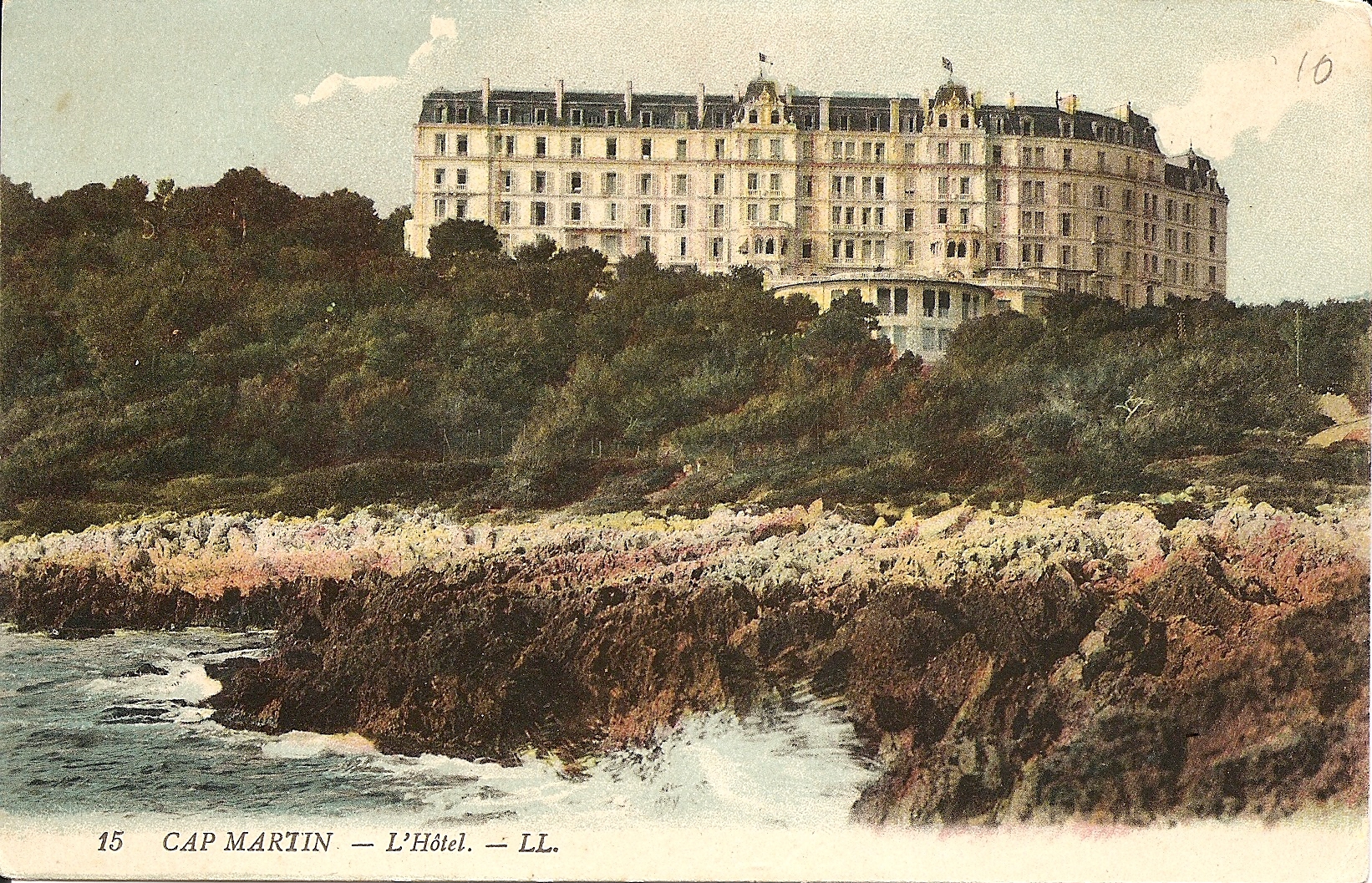
The Grand Hôtel du Cap-Martin in the 1910s, Tersling’s landmark at the tip of the cape.
The other empress on the cape was Eugénie, widow of Napoleon III. Tersling built Villa Cyrnos for her in 1892, on the land that neighbours Villa Cypris. Further west, King Leopold II of the Belgians was assembling his own Riviera estates around the turn of the century. Both are now known as Villa Leopolda and Villa Les Cèdres.
The private Domaine du Cap-Martin opened as an estate of villa plots in 1904. Cyprienne went on to secure the land beside the empress’s villa, and the former corset saleswoman now had an empress for a neighbour.
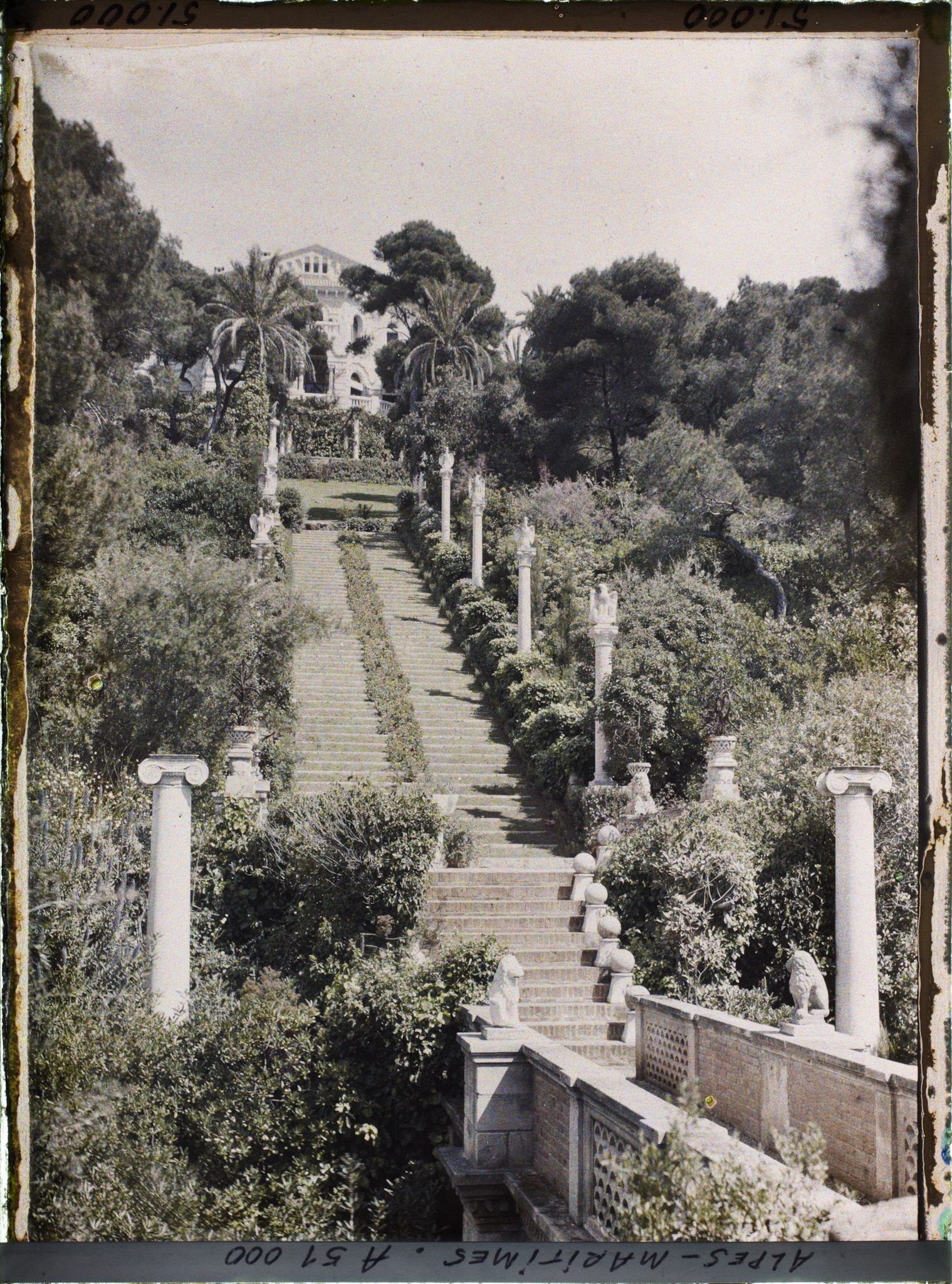
Villa Cypris above Mainella’s long stair to the sea. Credit: Département des Hauts-de-Seine, musée départemental Albert-Kahn, Archives de la Planète
She called the house Villa Cypris, and the name works on two levels. Kypris was an ancient title of Aphrodite, the goddess born from the sea off Cyprus. It also echoed the name of the woman who built it.
Her architect, Édouard Arnaud, also painted in watercolour. He gave her a Neo-Byzantine villa, in a style that looked east to the domes and mosaics of Constantinople and Ravenna. Nothing in the record explains the choice. Still, the timing is hard to ignore, because the house took shape in the years after the family’s voyage to Constantinople.
The state’s protection record names the client as Madame Douine. Cyprienne only took that name in December 1908, when she married Roger Douine. So when Raffaele Mainella laid out the garden in 1909, he was working for a newlywed.
Mainella came to gardens as a painter. Born in Benevento and trained in Naples, he made his name with watercolours of Venice and its lagoon. He also designed the villa’s interiors, as he did at Villa Torre Clementina, elsewhere in Roquebrune-Cap-Martin. At Villa Cypris he composed an entire hillside around a single view.
From the house, a central perspective plunges toward the water. A long flight of turfed steps, lined with columns, runs down the axis between two parallel stairways. Together with a bridge, it leads to a covered colonnade on the rocks below, where a cloister gallery frames the open sea in a row of arches. This is the gallery Dumas photographed in 1923.
Around this axis, Mainella arranged a series of set pieces. A Venetian-style loggia suits a painter of Venice, and a sunken Dutch garden holds a long canal. The most theatrical element is the pergola, where sixteen marble pillars carry brick arches designed to recall a ruined mosque. Kathryn Bradley-Hole, the garden historian, traces those arches to the Mosque-Cathedral of Córdoba.
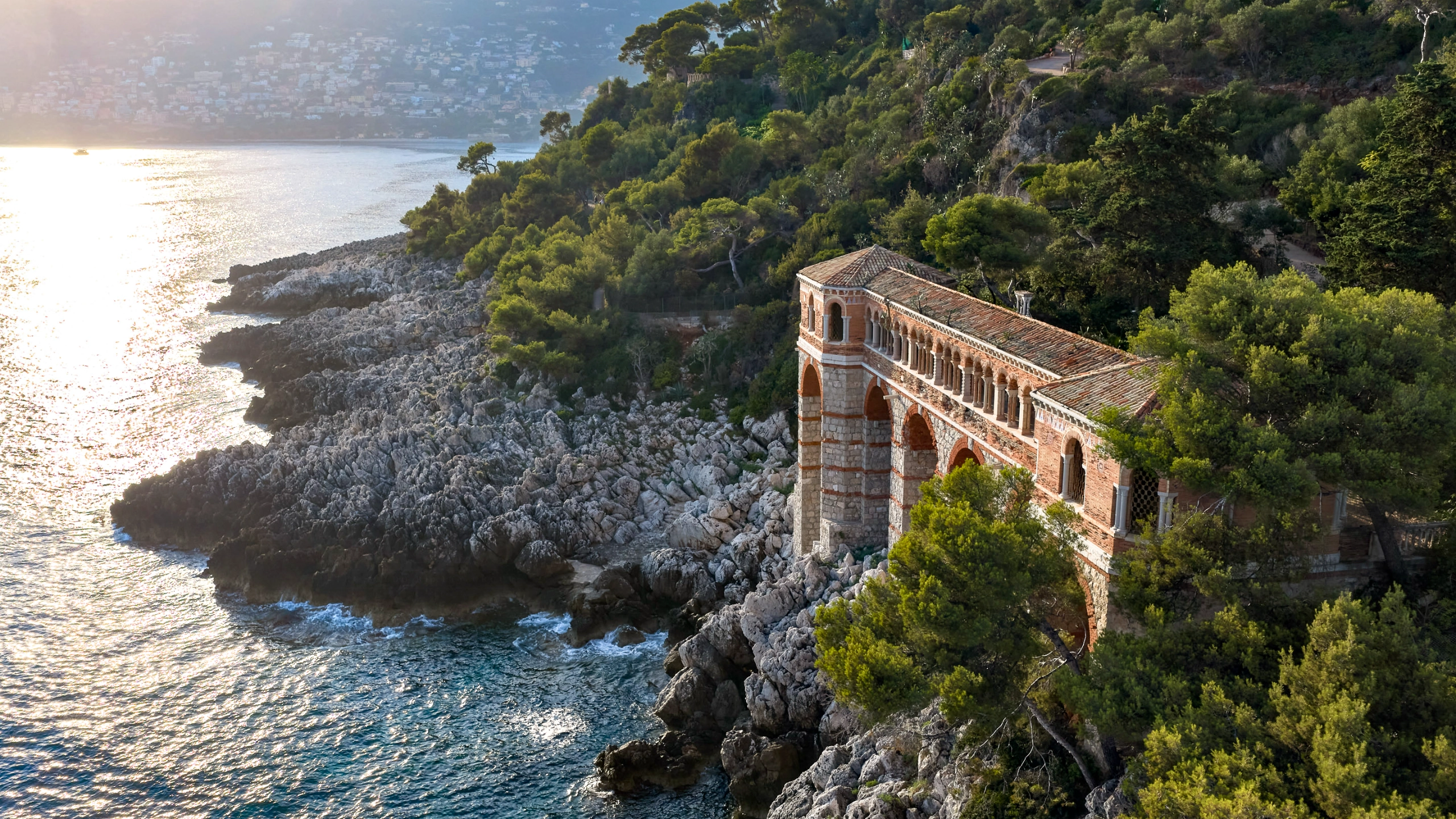
The cloister gallery at the water’s edge, Cyprienne’s lookout over the bay.
The gallery had another purpose. According to Bradley-Hole, it gave Cyprienne a place from which to watch her daughter sailing in the bay below.
That daughter, Virginie Hériot, became one of the great figures of interwar yachting. In 1921 she bought Finlandia, an 85-metre steam yacht, and moved aboard. Two years later she replaced it with Ailée, a steel schooner built at Kiel in 1909 as Meteor IV for Kaiser Wilhelm II. She lived on board for ten months of the year.
At the Amsterdam Olympics of 1928, Virginie won gold in the 8 Metre class aboard her own Aile VI, the only woman in a crew of six. The British called her the greatest yachtswoman in the world. The poet Rabindranath Tagore gave her the name that stuck: Madame de la Mer.
Early in 1932, a storm between Venice and Greece left her with two broken ribs and an injured liver. Still, she refused to rest. At the Arcachon regatta that August she fainted shortly before the start but raced regardless. As her boat crossed the finish line, she collapsed again. She died the next day aboard her yacht, aged forty-two.
She had asked to be buried at sea. Instead her coffin went into the family vault at La Boissière-École, and Cyprienne outlived her by thirteen years. Only in 1948 did Virginie’s son honour her wish, committing her coffin to the sea off Brest. An avenue on Cap Martin carries her name.
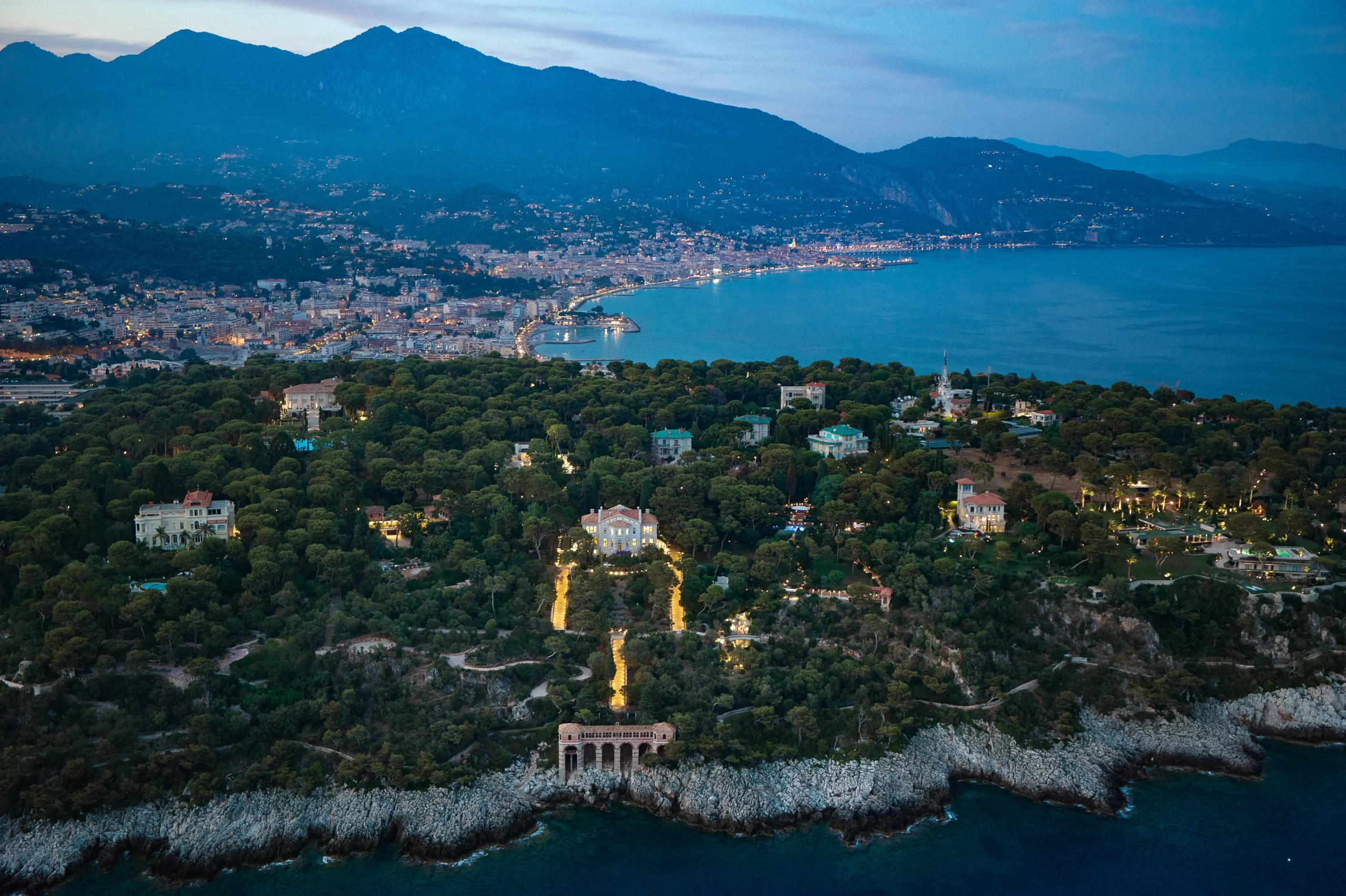
Cap Martin by night, a private peninsula between Monaco and Menton.
More than a century later, Cap Martin has kept its private character. Apart from the main road and the coastal path, most of the peninsula remains closed to the public. The landscape also has its own protection. Cap Martin has been a site classé since 1974, the higher of the two levels of landscape protection under French law. The wider coastline, meanwhile, has been a site inscrit since 1973.
Below the villas runs the coastal path, the old customs officers’ trail now named Promenade Le Corbusier. At its western end, near the Cabbé cove, Le Corbusier’s Cabanon and Eileen Gray’s villa E-1027 form the Cap Moderne site. Le Corbusier died while swimming off this shore in 1965, and he lies in the village cemetery above.
Above the cape, the medieval village of Roquebrune keeps its thousand-year-old castle. The commune belonged to the Grimaldis until the mid-nineteenth century, and Monaco remains its closest neighbour. From Villa Cypris, the view runs south-west across the bay toward the Principality. Our guide to the best places to live on the French Riviera sets Cap Martin in context, and current opportunities appear on our Roquebrune-Cap-Martin page.
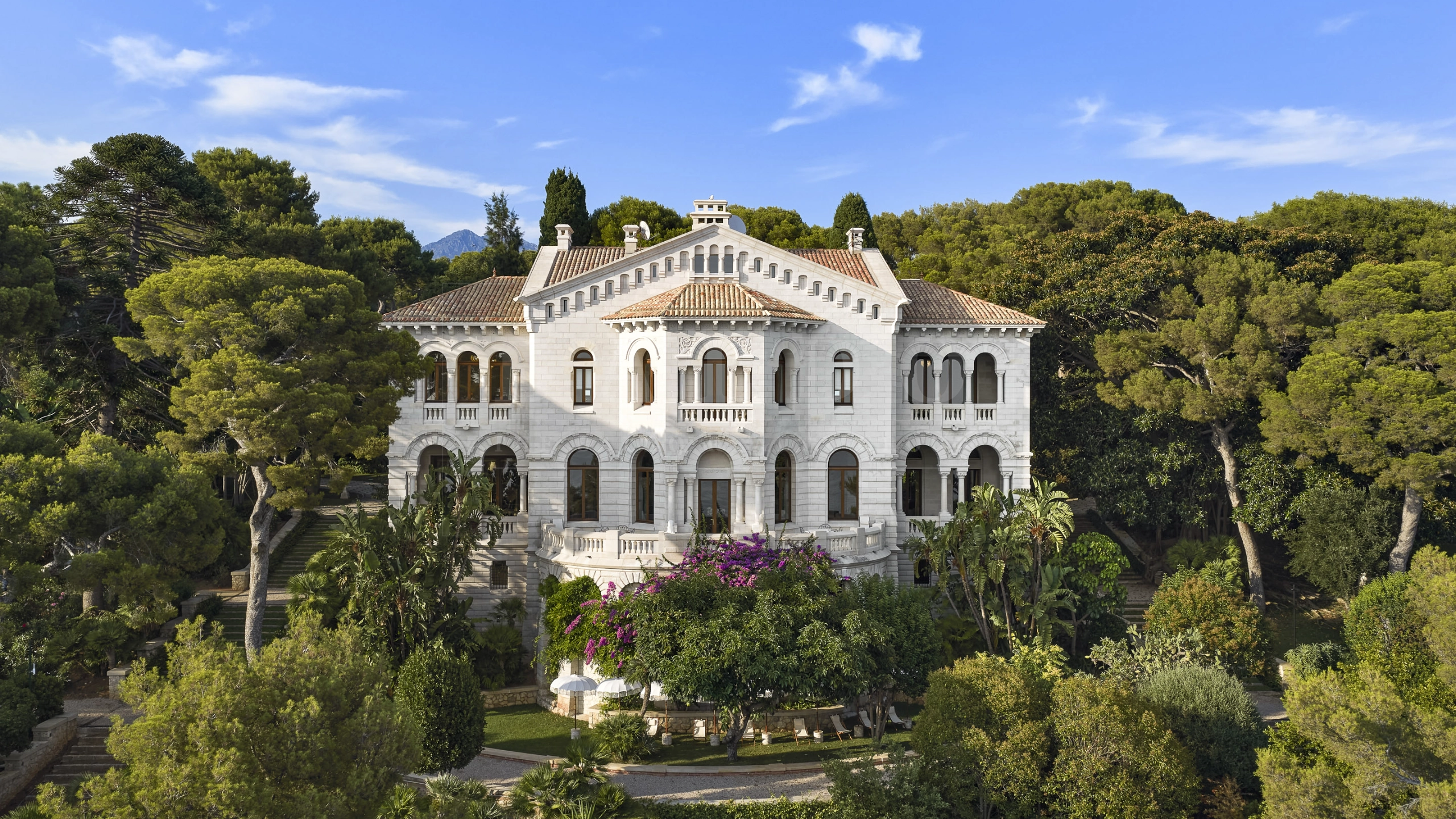
The main residence, Édouard Arnaud’s Neo-Byzantine villa above Mainella’s garden.
A century on, the estate is arranged for the way large households live and entertain, within the limits its protection sets. The grounds extend over 40,600 square metres, just over four hectares, and descend to the shore. Alongside Mainella’s gallery and pergola stand a belvedere and two chapels. There is also a heated swimming pool of 20 by 6 metres, with its own changing rooms and showers. Five loggias and nine garages complete the estate.
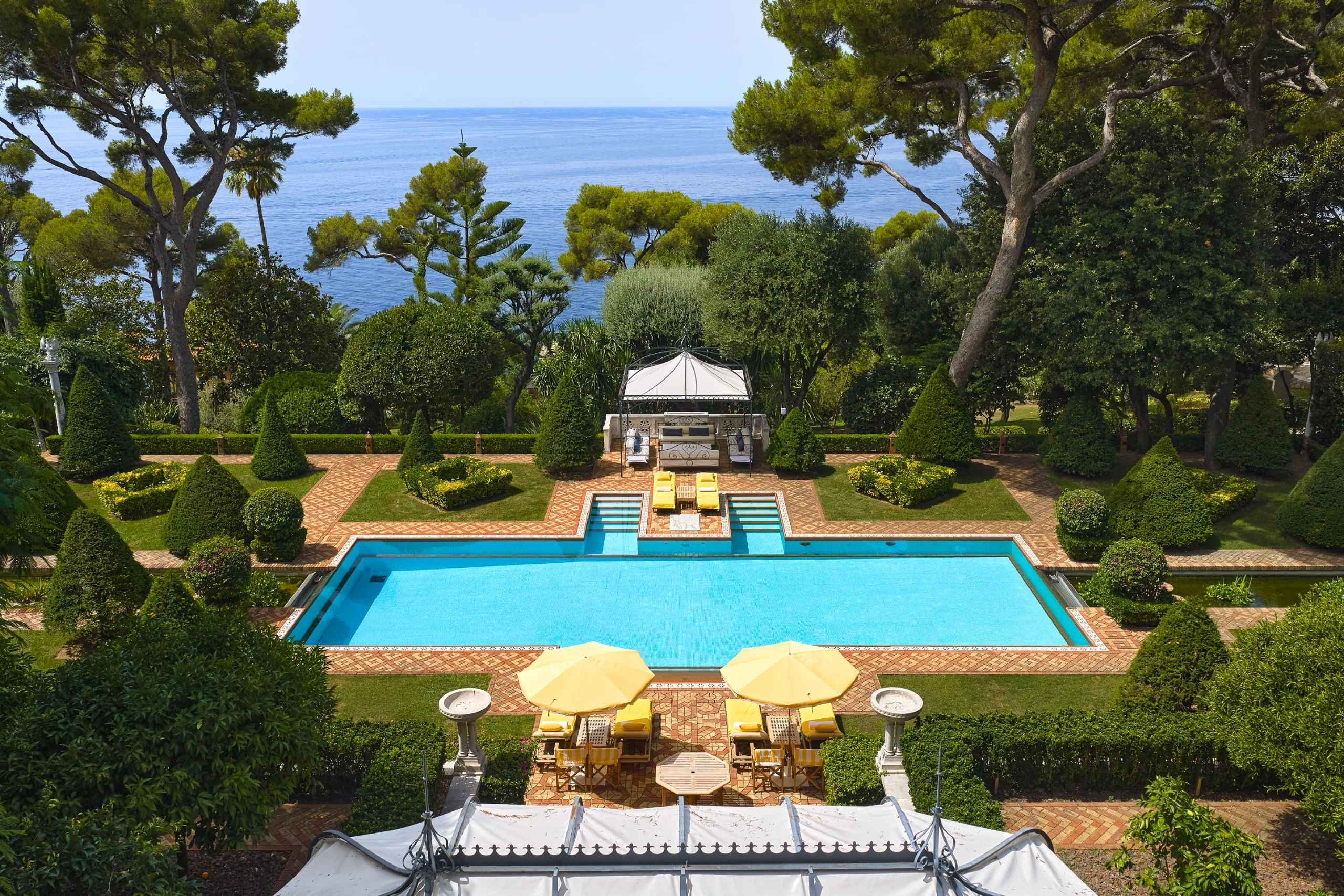
The heated 20-metre pool, seen from above.
The main residence offers more than 1,200 square metres over five levels, all served by a lift. On the principal floor, an entrance hall leads to two reception rooms, a dining room and a loggia that opens onto a terrace above the sea. The upper floors hold eight bedrooms, each with its own bathroom. The principal suite has a private balcony, and four further suites occupy the top floor.
For leisure, the house includes a spa with sauna and hammam, a gym, a billiards room, a private cinema and its own nightclub. Meanwhile, a kitchen, laundry, linen room and separate service access keep the running of the household apart from family and guests.
Beyond the main house, a guest house of around 215 square metres has its own principal suite, two further bedrooms and a staff room. A separate building of around 165 square metres also provides five bedrooms for household staff.
Villa Cypris at a Glance
Setting
Domaine Privé du Cap-Martin, Roquebrune-Cap-Martin, facing south-west
Grounds
40,600 m², just over four hectares, descending to the shore
Main residence
More than 1,200 m² on five levels with lift, eight en-suite bedrooms
Additional buildings
Guest house of around 215 m², staff house of around 165 m²
Leisure
Spa, gym, cinema, nightclub, billiards room, heated 20 × 6 m pool
Architecture and garden
Édouard Arnaud, architect; Raffaele Mainella, garden and interiors
Heritage status
Inscribed monument historique since 1990, within the Cap Martin site classé
In September 1990, the French state inscribed Villa Cypris as a monument historique. The order covers the property in its entirety: the buildings, gates and pavilions, the gardens with their paths, stairways and water features, the follies, the stonework, the sculpture and the ornament. The garden also has its own entry in the national heritage inventory.
In practice, Article L621-27 of the Code du patrimoine requires four months’ notice to the state before any modification. Where works need a building permit or a planning declaration, the heritage authorities must also give their agreement, and their services follow the works through to completion. Routine maintenance and repairs, however, need no authorisation.
The setting has protection of its own. Because the cape is a site classé, the wooded slope and the shoreline below the villa also fall under the state’s landscape protection. Our notes on renovating on the French Riviera cover the practical side of major works in the region.
Sources
Ministère de la Culture, Base Mérimée: Propriété dite Villa Cypris (PA00080958)
Ministère de la Culture, Inventaire général: Jardin de la villa Cypris (IA06001330)
Département des Hauts-de-Seine, musée Albert-Kahn: Galerie byzantine du jardin de la villa Cypris, autochrome by Roger Dumas
Image credits: Département des Hauts-de-Seine, musée départemental Albert-Kahn, Archives de la Planète collection
Ministère des Armées, Cols bleus: Virginie Hériot, une navigatrice au sommet de l’Olympe
Bibliothèque nationale de France, Gallica: Virginie Hériot, une âme à la mer
Kathryn Bradley-Hole: Villa Gardens of the Mediterranean, Aurum Press
Stephen Ong Pin Fine Art: Raffaele Mainella, biography
Côte d’Azur France: Le Grand Hôtel du Cap
Côte d’Azur France: Monument to Empress Elisabeth of Austria
Légifrance: Code du patrimoine, Article L621-27
Ministère de la Culture: Intervenir sur un immeuble inscrit
Département des Alpes-Maritimes, Randoxygène: Tour du Cap Martin