Post 8 min read
On the western shore of Saint-Jean-Cap-Ferrat, where the Maritime Alps descend toward the Mediterranean, Villa Les Cèdres occupies 14 hectares of some of the most consequential land on the French Riviera. The estate encompasses a 14-bedroom Belle Époque mansion of approximately 1,700 square metres, an Olympic-length swimming pool carved into the bedrock, a chapel dedicated to Saint François de Sales, stables originally built for 30 horses, and the largest private botanical garden in Europe. It is, by most credible accounts, the single property that has done more to shape the identity and pricing of Cap Ferrat than any other.
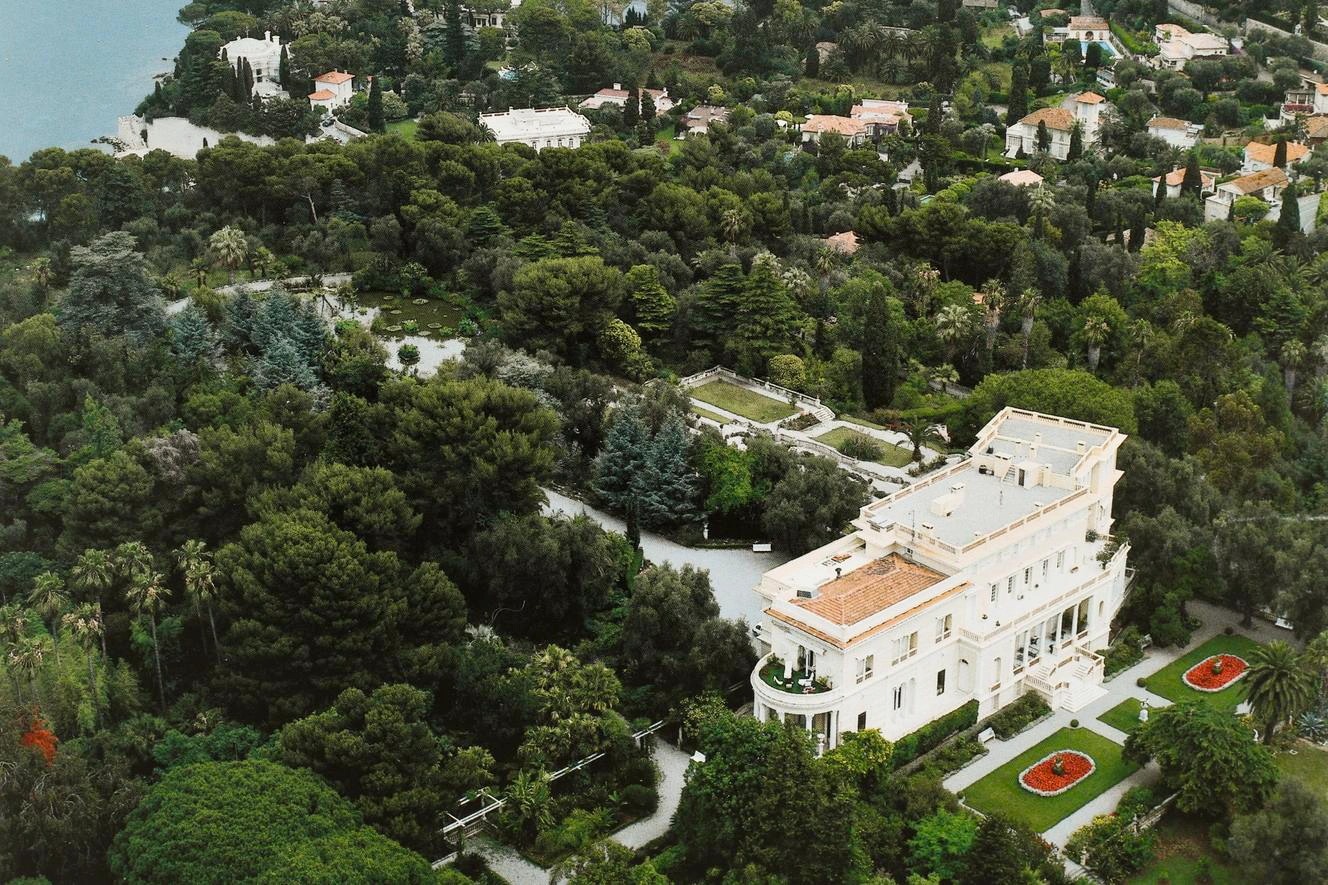
Villa Les Cèdres and its 14-hectare botanical park, seen from above the western shore of Saint-Jean-Cap-Ferrat
The villa’s interior reflects its succession of owners across nearly two centuries: grand sitting rooms with chandeliers and floor-to-ceiling 19th-century portraits, a wood-panelled library housing 3,000 volumes on flora and naturalism (including a 1640 botanical codex valued at several hundred thousand euros), and a bronze statue of Athena draped in a marble tunic standing guard at the entrance. None of it is pastiche. Every element is original or period-consistent, accumulated through generations of occupancy by royalty, industrialists, and global capital.
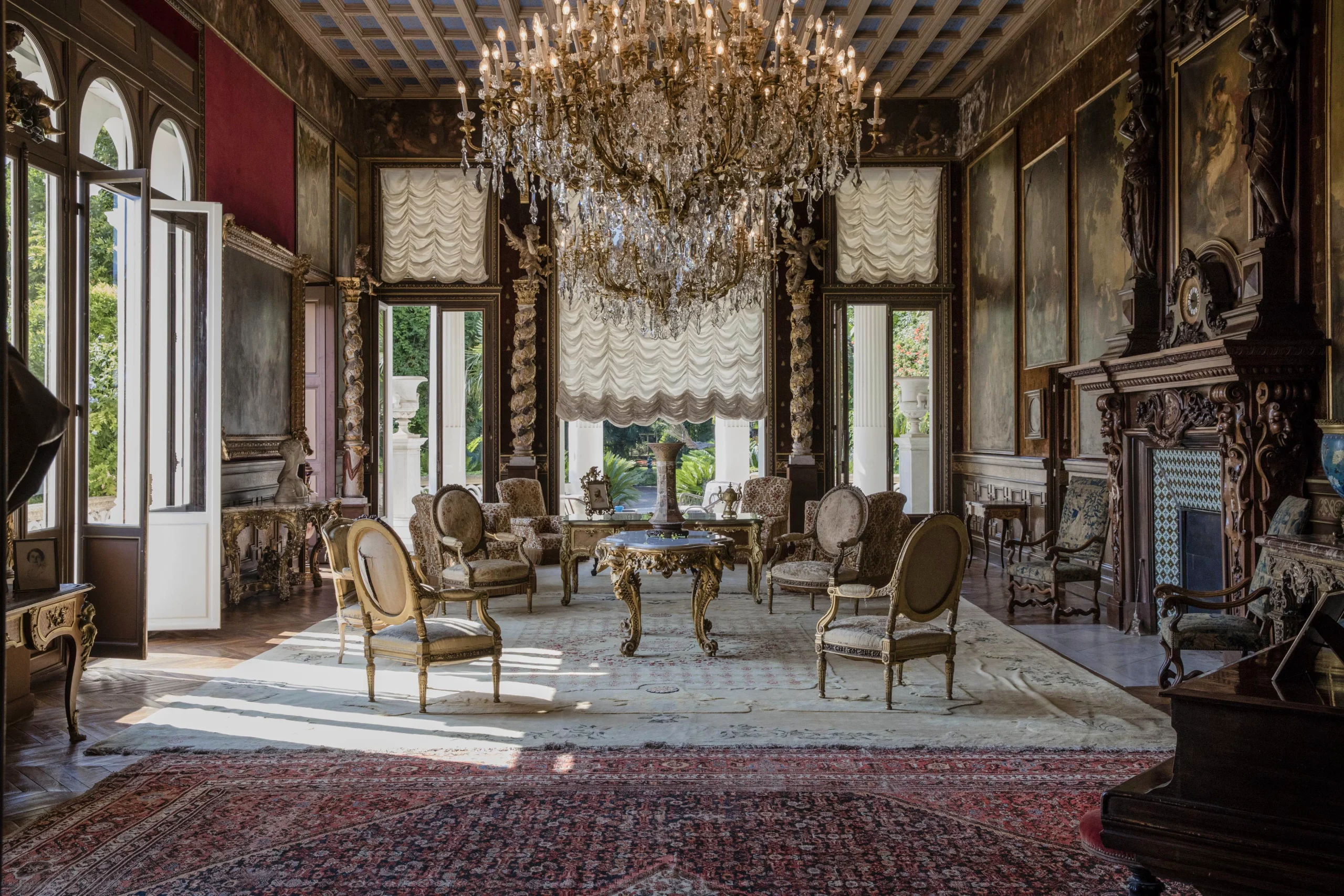
One of the villa’s grand salons, with original chandeliers and 19th-century portraits from floor to ceiling
The structure that would become Villa Les Cèdres was built around 1830 in the Sardinian architectural style, on land that then belonged to the commune of Villefranche-sur-Mer. Originally named Villa Les Oiseaux, it was acquired in 1850 by David-Désiré Pollonnais, who served as mayor of Villefranche-sur-Mer from 1872 to 1900. Under Pollonnais, the 35-acre property functioned as both a residence for hosting French dignitaries and a working olive farm. Several of those original olive trees, now over three centuries old, remain on the grounds.
The Pollonnais family, of Polish-Jewish origin and established in the textile trade in Nice, expanded the villa over the following decades. It was a substantial property, but not yet the landmark it would become. That transformation required a buyer with resources on an entirely different scale.
In 1904, King Leopold II of Belgium purchased the Pollonnais estate, renaming it Les Cèdres after the cedar trees that lined its grounds. The king, who had been acquiring property across Cap Ferrat since the mid-1890s, turned to his preferred architect, Aaron Messiah, a native of Nice born in 1858, to undertake a wholesale transformation.
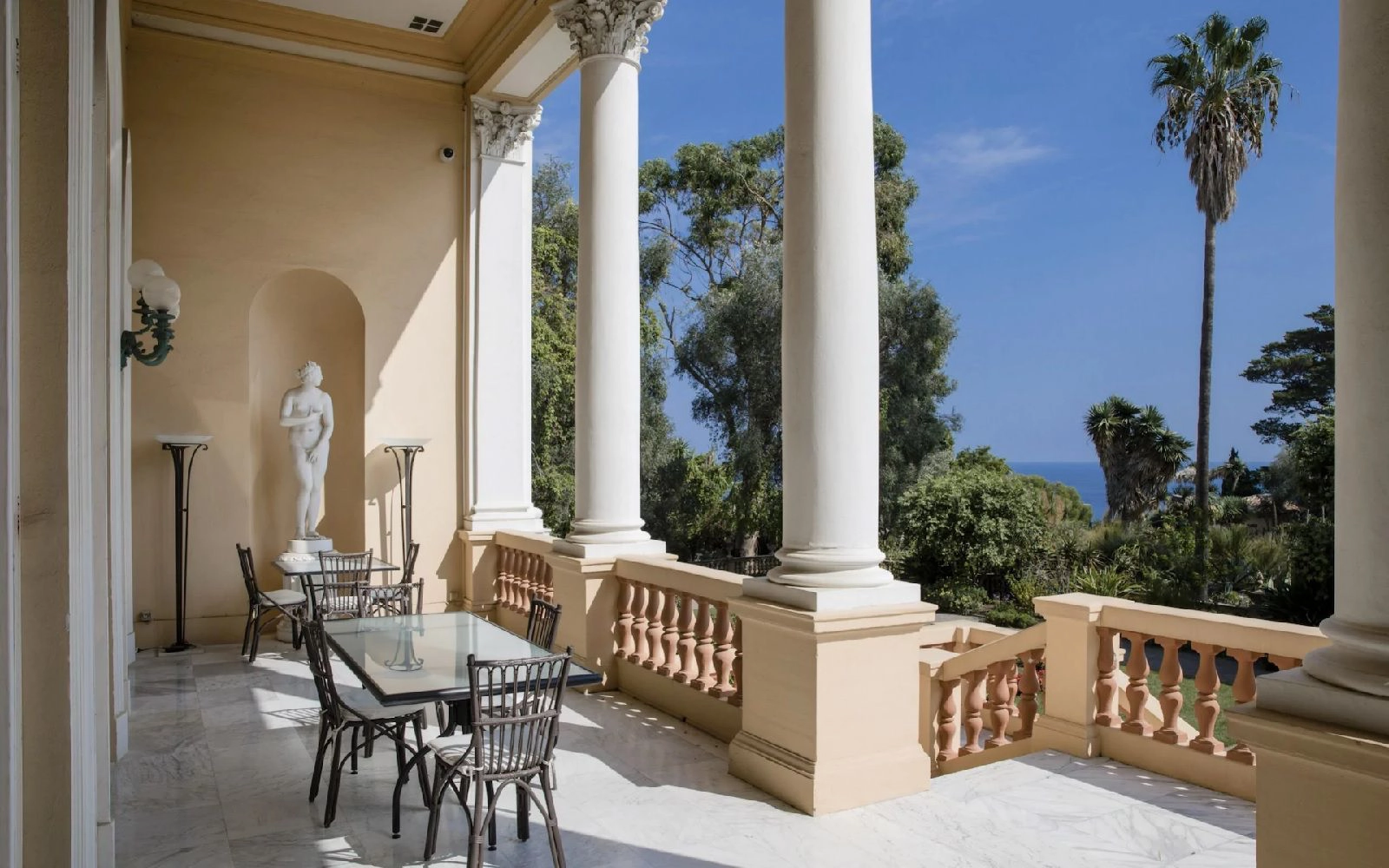
Messiah added a complete third storey to the original structure and constructed a new wing finished with a large peristyle supported by massive pillars. The landscape was simultaneously reimagined under the direction of Jules Vacherot, the chief landscape architect of the city of Paris and designer of the 1900 Exposition Universelle grounds, and Harold Peto, the English garden architect responsible for several notable Riviera villa gardens. Together, they laid the foundations of the terraced garden system, the formal flowerbeds, the sculpted arches, and the Corinthian-columned entrance to the stables that survive in recognisable form.
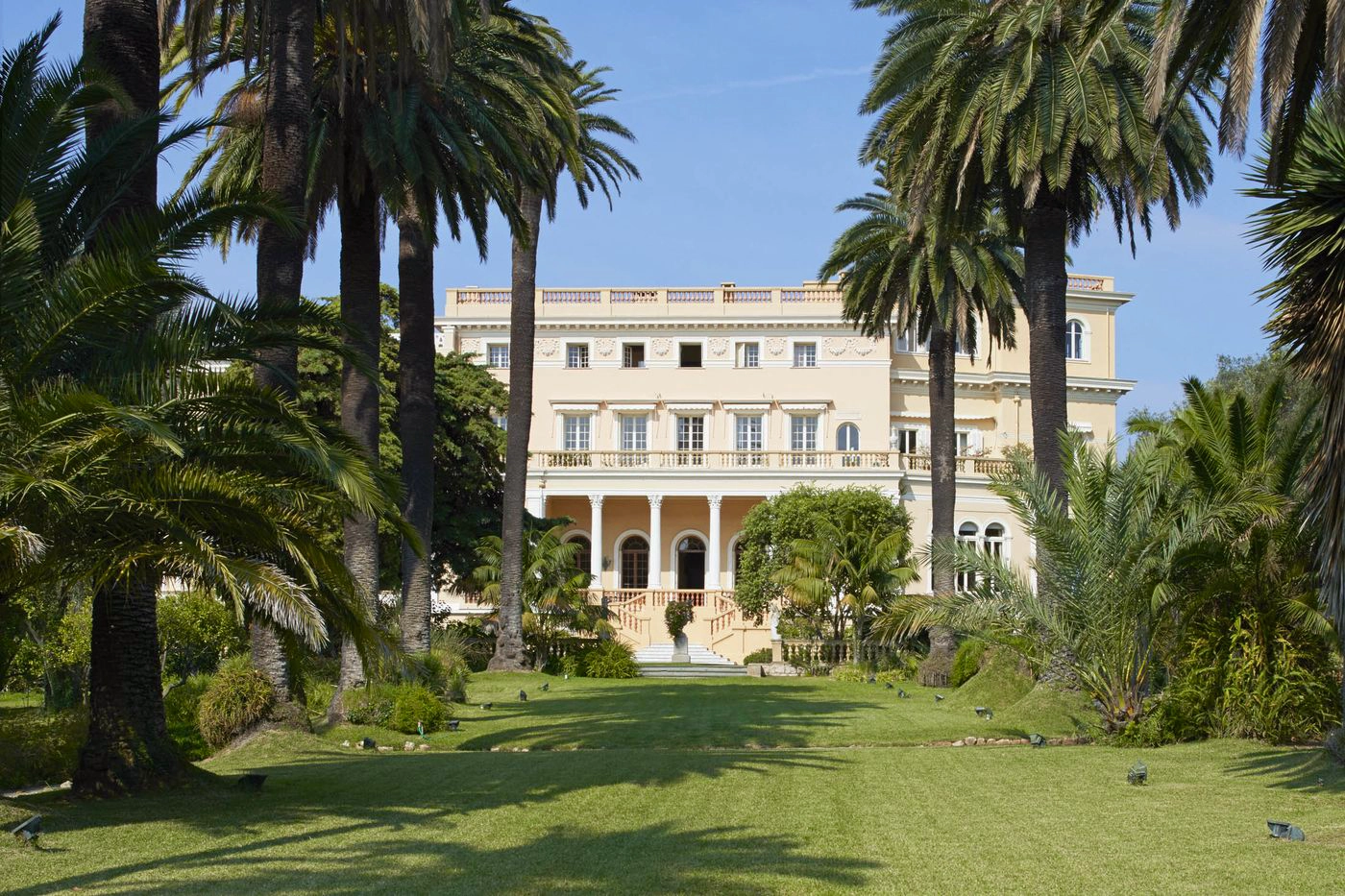
The principal façade, with the peristyle and columns added by Aaron Messiah for Leopold II after 1904
Leopold installed his companion, Blanche Delacroix, later known as Caroline Lacroix and eventually granted the title Baronne de Vaughan, at the neighbouring Villa Radiana on the estate grounds. The king’s frequent extended stays on Cap Ferrat drew criticism in Brussels, but his investments left an architectural imprint on the peninsula that persists well beyond his reign. After his death in 1909, ownership passed briefly to his nephew, King Albert I of Belgium.
The botanical garden at Les Cèdres spans 14 hectares and contains more than 14,000 species of tropical and subtropical plants, roughly two-thirds of which are maintained within 25 heated greenhouses. The collection includes nearly 200 species of palm trees and cycads, a grove of bamboos, an equatorial forest section, extensive Bromeliaceae and Cactaceae displays, and aquatic plantings including Victoria amazonica. By species count, it ranks among the ten most significant botanical gardens in the world and holds what is considered the largest private tropical plant collection in Europe.
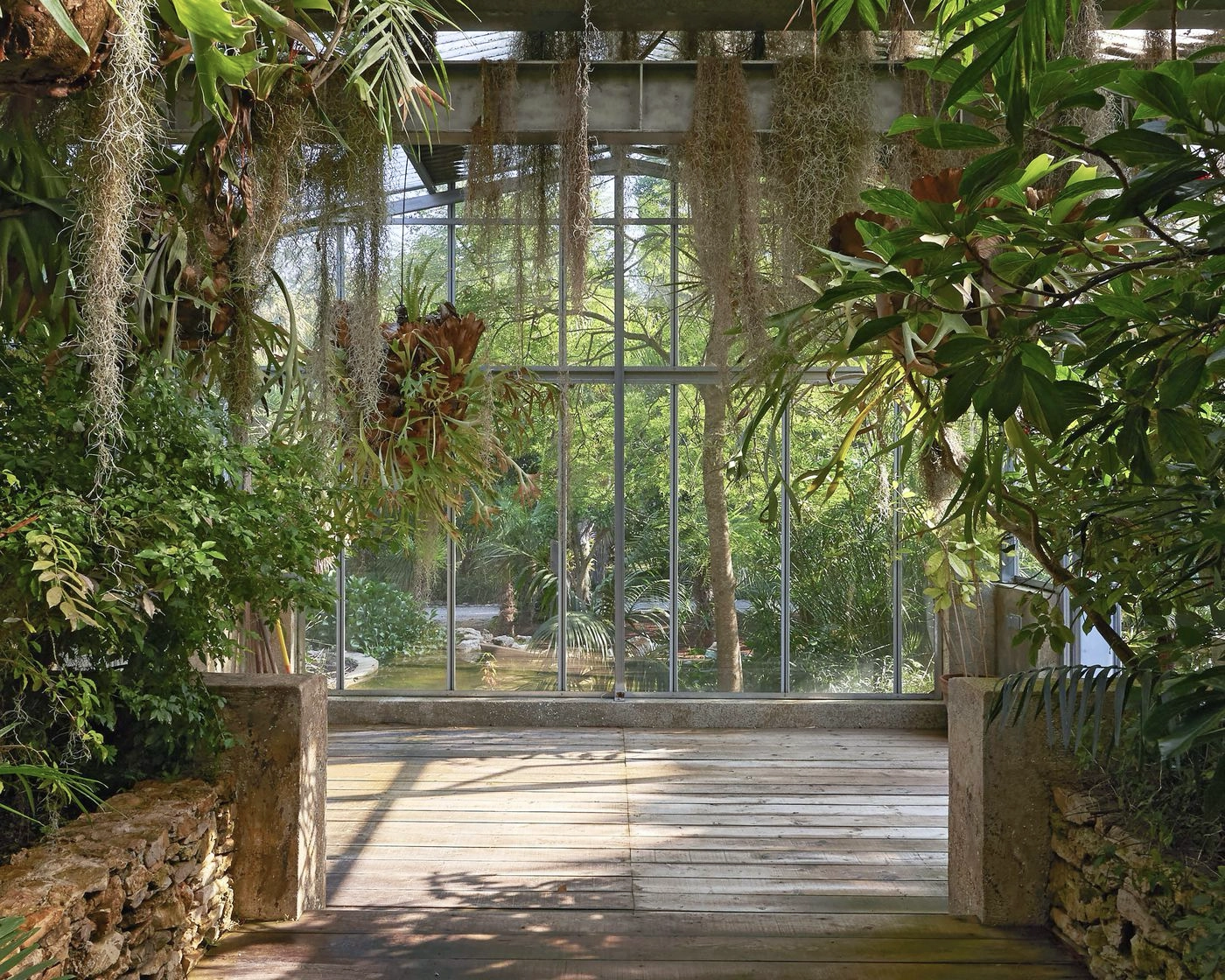
Inside one of the 25 heated greenhouses, where two-thirds of the botanical collection is conserved year-round
The estate was catalogued in France’s Inventaire général du patrimoine culturel in 2008. The botanical gardens, greenhouses, chapel, and associated garden structures received formal inscription as a Monument Historique by ministerial decree in 2021, a classification that places them under the protection of French heritage law. Franklin Picard, who published a reference monograph on the gardens in 1999, described the collection as “the Louvre of botany,” a characterisation that speaks less to aesthetics than to the depth and scientific rigour of what the Marnier-Lapostolle family built over eight decades.
Fifteen full-time gardeners maintain the collection. The work is not horticultural decoration; it is species preservation on a scale that most national institutions would struggle to match.
In 1924, fifteen years after Leopold’s death, the estate was acquired by Alexandre Marnier-Lapostolle, creator of Grand Marnier, the cognac and bitter orange liqueur that had become one of France’s most recognisable spirits exports. From 1928, his son Julien intensified the cultivation of exotic species with a genuinely scientific approach, transforming what had been Leopold’s ornamental grounds into one of the most important private research gardens in the Mediterranean.
The family harvested bigarades, the bitter oranges grown in the estate’s orchards, to flavour their signature liqueur. It was a rare instance of a globally distributed spirit drawing its botanical ingredient from a private garden on one of the world’s most expensive residential peninsulas. The Marnier-Lapostolle stewardship lasted more than 80 years and six generations, a continuity of ownership that contributed substantially to the integrity of both the property and the collection.
In 2016, Davide Campari-Milano SpA acquired Société des Produits Marnier Lapostolle (SPML), the parent company of Grand Marnier. Villa Les Cèdres was included among the non-core assets in the acquisition. Campari engaged Savills to market the property, initially listing it at €350 million. Press speculation ranged far higher: Nice-Matin floated a valuation of €1 billion, Le Figaro suggested €300 to €500 million, and Bloomberg initially referenced the €350 million asking price.
The property sat on the market for three years. In August 2019, Campari announced a preliminary agreement to sell the villa for €200 million (approximately USD 221 million at the prevailing exchange rate). The buyer was later identified as Rinat Akhmetov, Ukraine’s wealthiest individual, whose holding company SCM Holdings Limited described the purchase as a long-term investment. Campari retained approximately €80 million from the net sale proceeds as part of the divestment of SPML’s non-strategic assets.
Even at the final transaction price, significantly below the initial ask, the sale ranks among the most expensive residential property transactions ever recorded globally.
Villa Les Cèdres is not merely large or expensive. Its significance lies in the layering of distinct historical periods within a single coherent estate. The Sardinian-style foundations of the 1830s, Leopold’s Belle Époque expansion with Messiah’s peristyle and Vacherot’s formal terraces, the Marnier-Lapostolle family’s scientific botanical programme: each phase added to the property without erasing what came before. That palimpsest quality is exceedingly rare in French Riviera real estate, where renovation and demolition cycles tend to destroy provenance.
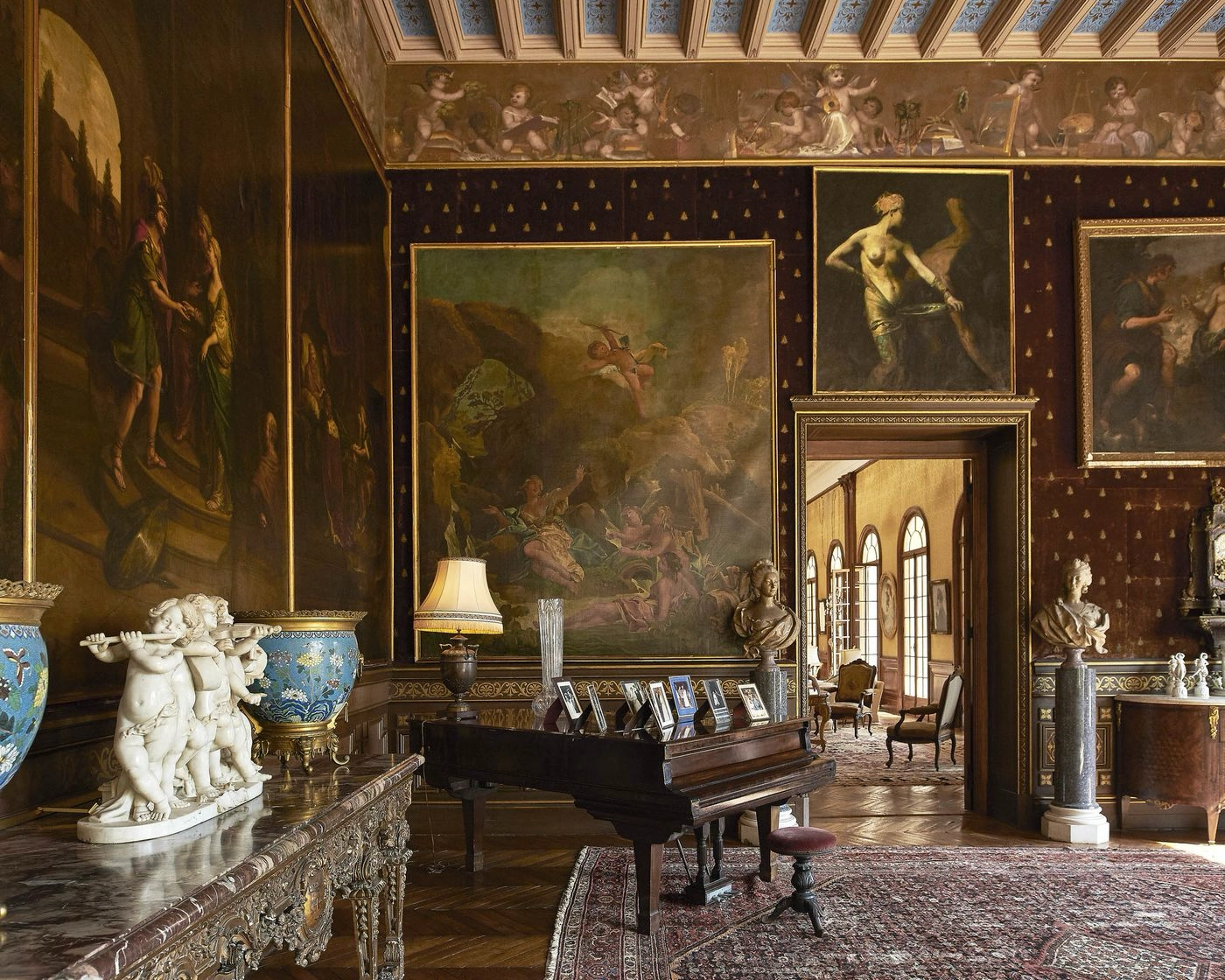
Period furnishings and collected artwork in one of the villa’s reception rooms
The Monument Historique classification of the gardens in 2021 formalised what specialists had recognised for decades. The estate is not simply a private residence with attractive grounds; it is a documented piece of European cultural heritage whose botanical collections alone justify institutional-level conservation protocols.
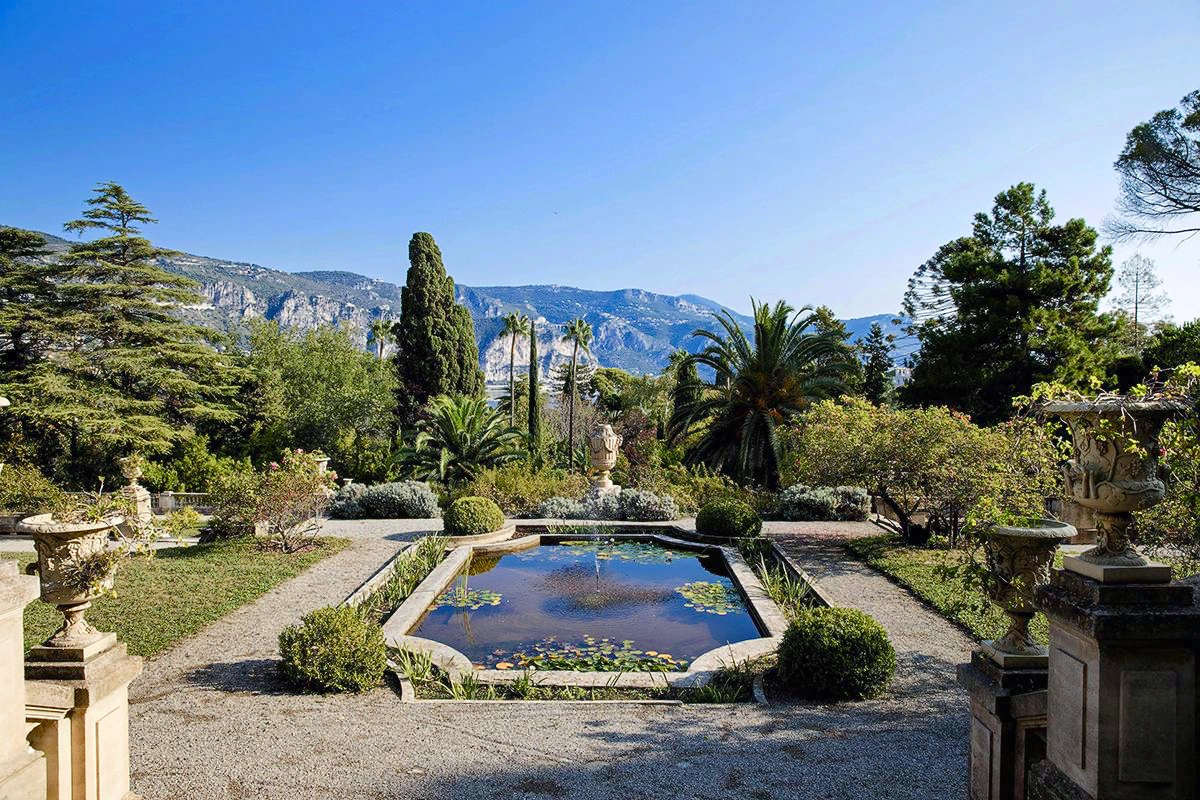
The formal grounds, with an ornamental pond and the Maritime Alps beyond
Saint-Jean-Cap-Ferrat has long been called the “peninsula of billionaires,” and Les Cèdres is the property that set the standard. Its sale at €200 million, while below the initial listing price, confirmed that Cap Ferrat can sustain nine-figure residential transactions. The estate’s pricing history, from Savills’ €350 million listing to the eventual €200 million close, also illustrates the discipline that the ultra-prime market demands: even the most storied properties must be priced within a range that reflects genuine buyer appetite rather than aspirational valuation.
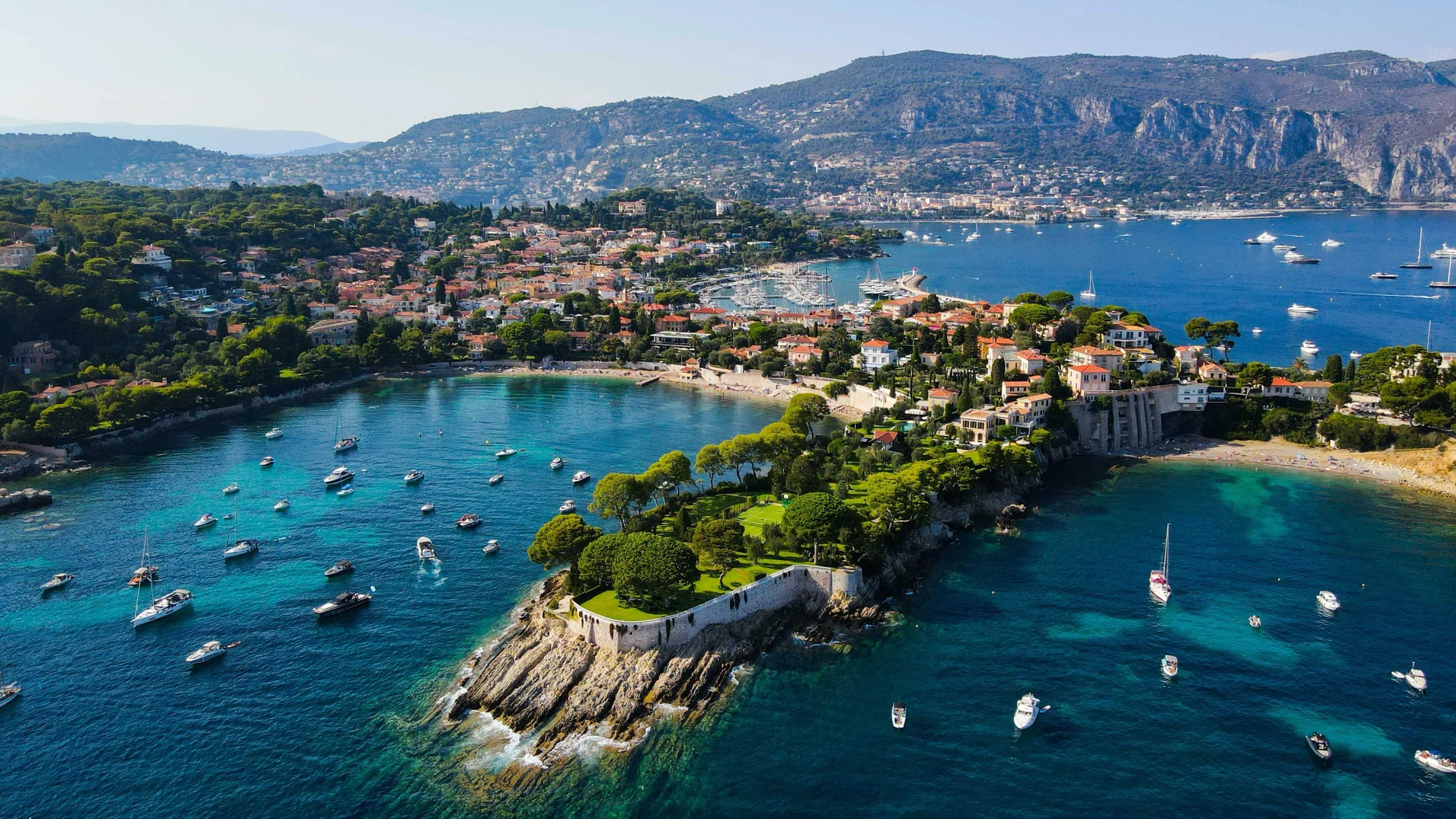
Saint-Jean-Cap-Ferrat from the air, the peninsula whose pricing Les Cèdres helped define
Neighbouring properties on the peninsula have included those of Andrew Lloyd Webber, the late Paul Allen, the Ferrero family, and a succession of Russian and Middle Eastern principals whose acquisitions over the past two decades have progressively tightened supply. Cap Ferrat offers what Monaco cannot: waterfront acreage measured in hectares rather than square metres, mature gardens that took a century to establish, and the kind of absolute privacy that new-build developments structurally cannot replicate.
For buyers and advisors evaluating the French Riviera’s trophy segment, Les Cèdres remains the benchmark. It is the property against which all others on the peninsula are measured, not because of its price, but because of what it contains: nearly two centuries of unbroken provenance, a botanical collection of global scientific value, and the architectural imprint of a king, an architect, and a family of distillers who each, in their own era, understood what this particular stretch of coastline was worth.
Baldo Realty Group advises clients on exceptional properties across the French Riviera, including Cap Ferrat. For a confidential discussion about the peninsula’s trophy market, get in touch with our team.
This article is provided for informational purposes only and does not constitute legal, tax, or investment advice. Prospective buyers should consult qualified professionals before making any property acquisition decisions.
Sources
Bloomberg – “Campari Finds Buyer for Exclusive French Villa at $221 Million” (2019)
Forbes – “The Most Expensive House In The World Could Sell For $1.1 Billion” (2016)
Monaco Life – “Ukraine oligarch buys €200m villa”
Wikipedia – Jardin botanique “Les Cèdres”
Monumentum.fr – Monument Historique: Domaine Les Cèdres (PA06000067) and Jardin des Cèdres (PA06000068)
Inventaire général du patrimoine culturel – Villa Les Oiseaux / Villa Les Cèdres (IA06000906)
Société Nationale d’Horticulture de France – “Le domaine des Cèdres à Saint-Jean-Cap-Ferrat”
The Spirits Business – “Campari Group to gain €80m from French villa sale” (2019)