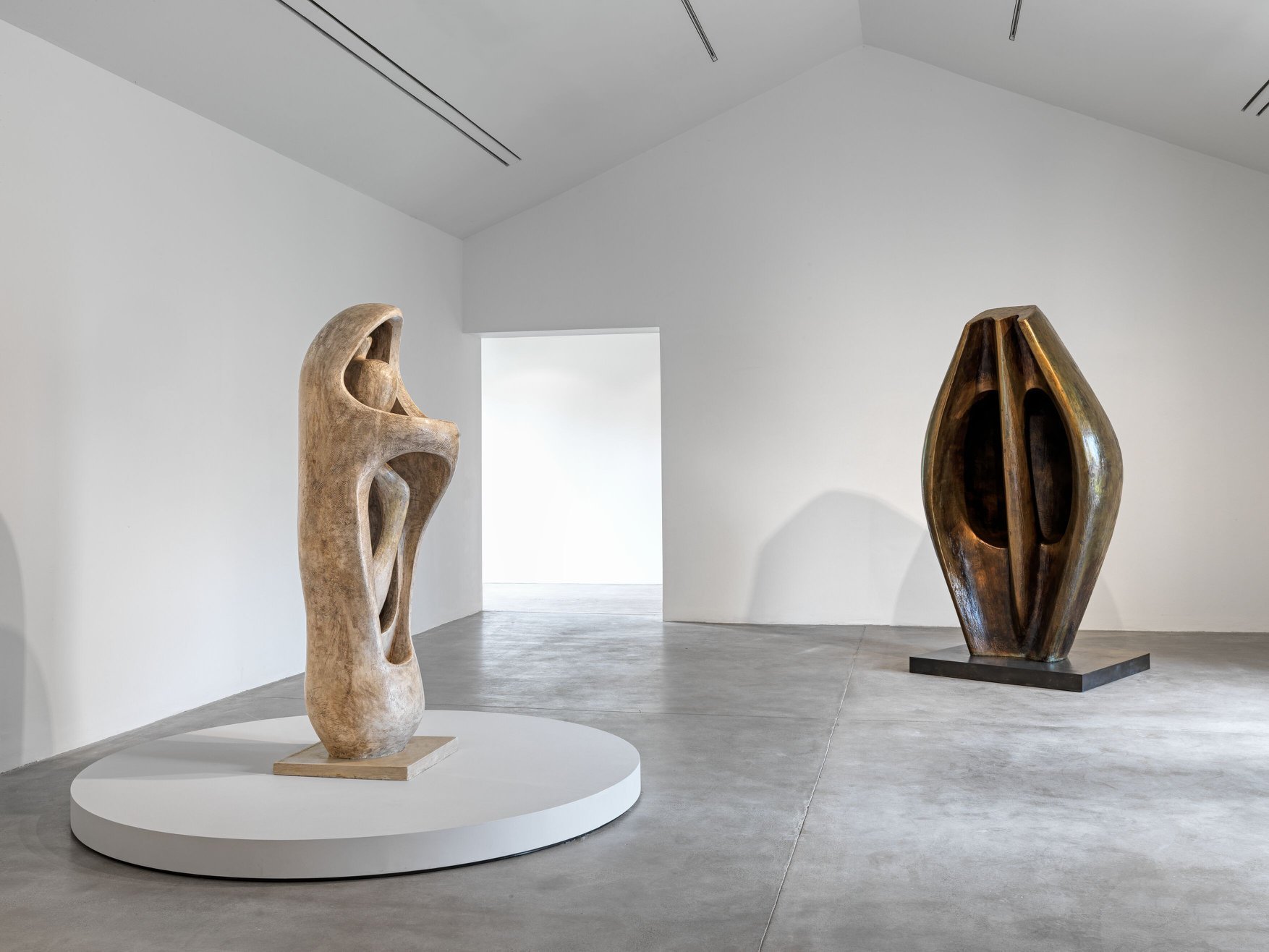
Post 9 min read
Collectors who spend real time in Monaco learn quickly that the principality’s relationship with art rarely announces itself. There is no gallery quarter here in the way Chelsea or Le Marais function as districts, no single street where the trade concentrates for casual browsing. Instead the market moves through hotel salons, private viewing rooms above the harbour, and a handful of institutions that keep their appointment books, quite deliberately, harder to find than their postcode.
That discretion is not incidental. It reflects a considered relationship with beauty that runs through how the principality thinks about its own architecture and public spaces, and it extends naturally to how residents live with art. For a buyer weighing where to live alongside what to collect, understanding the texture of that world, the fairs, the storage, the customs mechanics, and the rooms where business is actually done, is worth as much attention as the property market itself.
The global art market returned to growth in 2025, reaching an estimated USD 59.6 billion in total sales according to the Art Basel and UBS Global Art Market Report 2026. That 4% year-on-year increase followed two consecutive years of contraction, and art fairs in particular strengthened their share to 35% of dealer sales, up from 31% a year earlier. For Monaco, where the entire market revolves around one annual fair and a tight ring of private relationships, that structural shift toward in-person, event-driven transactions matches the way business has always been done here.
Monaco’s art year has a hinge point, and everyone in the trade plans around it. artmonte-carlo, established in 2016 and staged annually at the Grimaldi Forum under the patronage of HSH Prince Albert II, brings roughly thirty leading international galleries to the Riviera each July. It sits in deliberate conversation with artgenève, which opens the European fair calendar each winter in Geneva; artmonte-carlo closes the summer season on the coast, timed to overlap with the wider July auction and gala circuit.
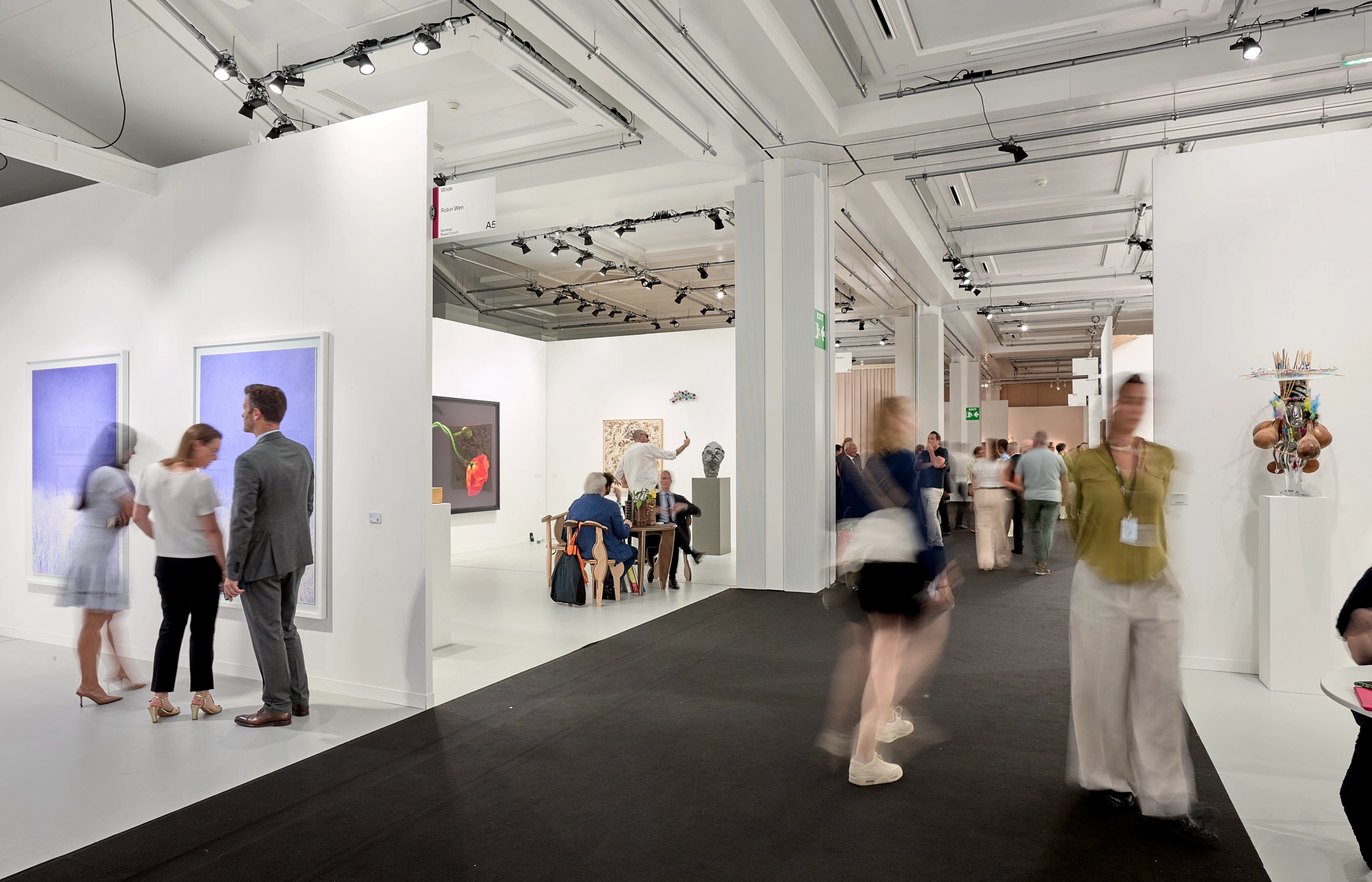
The floor at artmonte-carlo, where roughly thirty international galleries gather each July under the Grimaldi Forum’s roof.
The fair’s more lasting effect, though, is what it has pulled into the principality year-round. Hauser & Wirth opened a permanent Monaco space in June 2021, designed by longtime collaborator Selldorf Architects, becoming the first international megagallery to commit a standing space to the principality rather than simply exhibiting during fair week. A few streets away, facing the Hôtel Hermitage, Opera Gallery has held its ground since founder Gilles Dyan opened the Monaco branch in 1994, with over 400 square metres across the Palais de la Scala given to Modern and contemporary names from Picasso and Chagall to Soulages, deep in the Carré d’Or. Further along Avenue de la Costa, Galerie Adriano Ribolzi has traded in post-war Italian and European Modern masters since 1988, representing a secondary-market tradition that predates the megagallery arrivals by decades. Sotheby’s and Christie’s both maintain a Monaco office that predates the current gallery wave as well, coordinating consignments with their Geneva and Paris salesrooms rather than holding inventory locally.
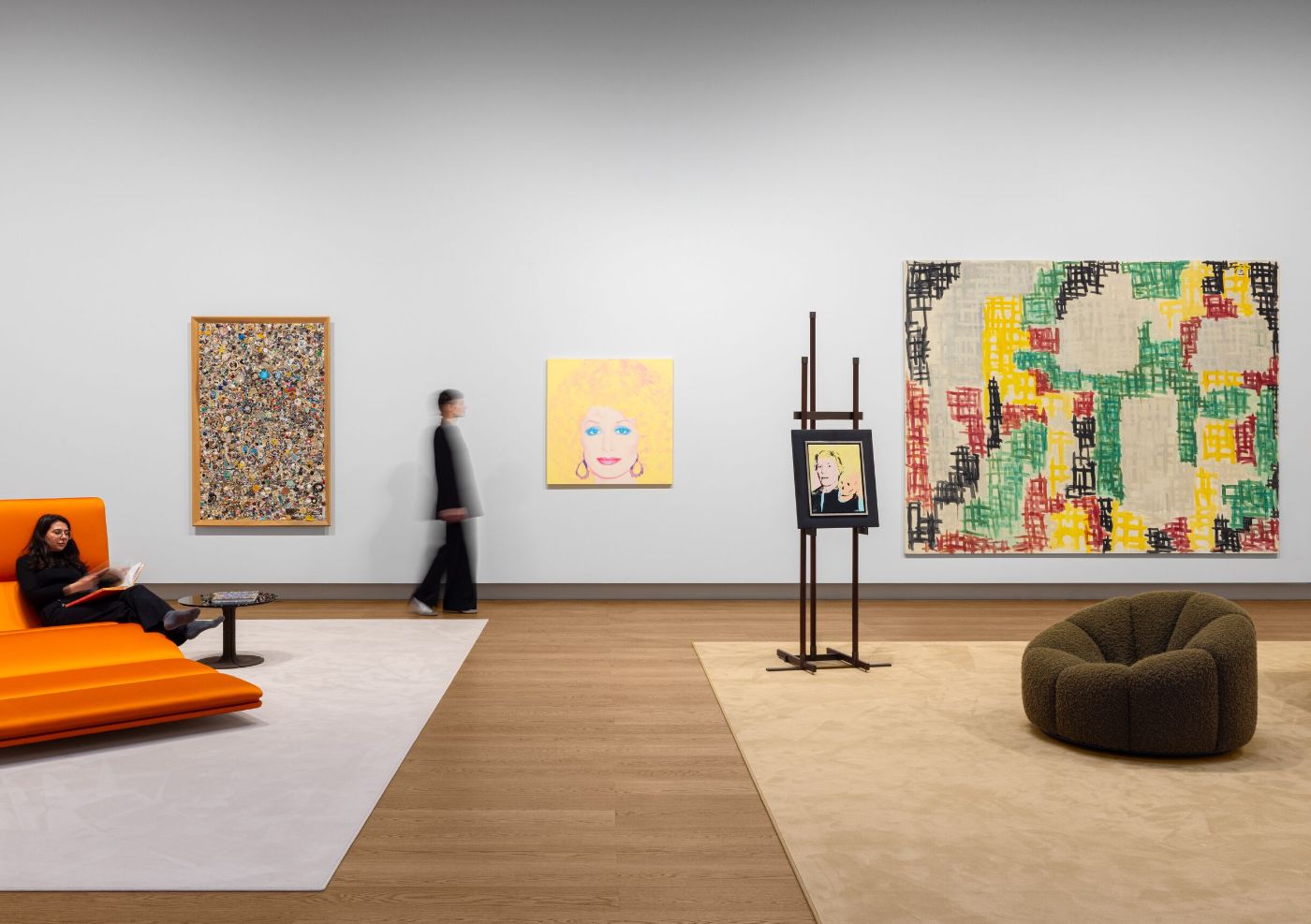
Inside Hauser & Wirth’s Monaco space, the first standing address a global megagallery has committed to the principality.
Institutionally, the Nouveau Musée National de Monaco carries the heavier curatorial weight, split across two Belle Époque villas. Villa Sauber sits near the Grimaldi Forum; Villa Paloma occupies its own garden along the Boulevard du Jardin Exotique. Between the two sites the museum mounts roughly two exhibitions a year each, a program that has ranged from Helmut Newton’s Riviera photography to surveys of ceramics and decorative arts, giving the market an institutional counterweight to the commercial galleries around it.
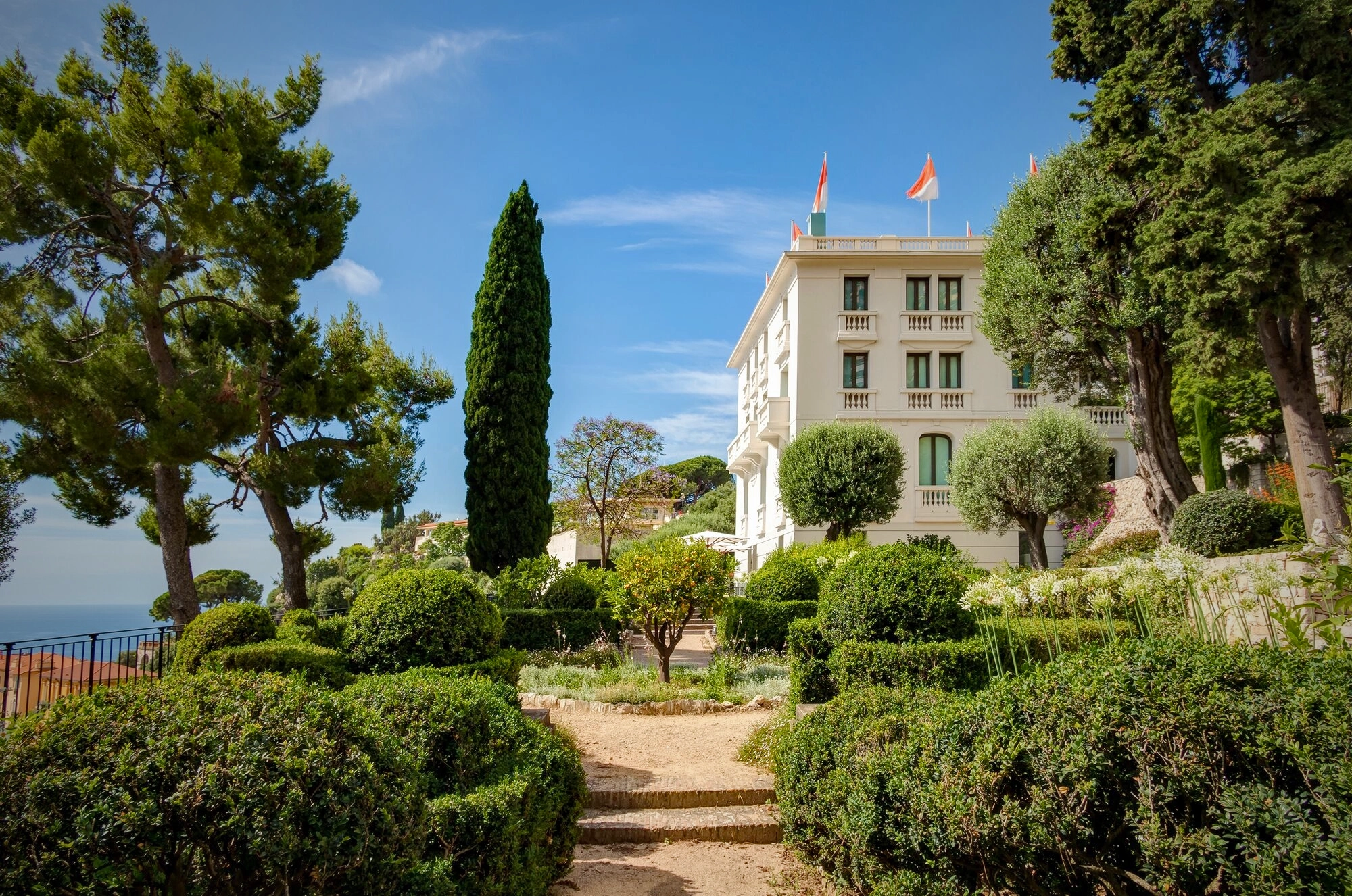
Villa Paloma, one of the Nouveau Musée National de Monaco’s two exhibition sites, set in its own garden off the Boulevard du Jardin Exotique.
Collectors based here also tend to treat the wider Riviera as an extension of the local calendar rather than a separate destination. The Fondation Maeght, forty minutes west in Saint-Paul-de-Vence, remains one of Europe’s great private art foundations. Opened in 1964 by dealers Aimé and Marguerite Maeght with architect Josep Lluís Sert, its grounds hold in-situ work by Giacometti, Miró, Chagall, Braque and Calder among a collection of more than 13,000 pieces. It is the kind of afternoon that regularly finds its way onto a Monaco-based collector’s weekend, alongside Nice’s Matisse and Chagall museums.
None of this activity answers the question every serious collection eventually raises: where does a piece go when it is not on a wall. Monaco has had its own answer for longer than the recent gallery arrivals suggest.
Operating under the principality’s own customs and taxation code, the Monaco Freeport allows art, antiques and comparable valuables to enter and remain in storage without VAT, held anonymously and for an unlimited duration, provided the goods arrive directly from outside the European Union. Firms such as SMT Fine Art and Mathez Monaco Art Logistics handle the practical side: climate-controlled vaults, condition reporting, and the customs choreography that governs anything moving in or out. A newer 1,300 square metre facility built by Mathez a short drive from Nice airport has added capacity to a storage corridor already comparable in scale to the freeports of Geneva, Luxembourg and Singapore.
The freeport, in practice
No VAT on entry. Anonymous storage. No time limit on how long a work can remain. The only condition: goods must arrive directly from a country outside the EU, not via temporary admission through it.
The appeal for a Monaco-based collector is straightforward. Monaco levies no personal income tax, no capital gains tax and no wealth tax on its residents, which means there is no art-specific fiscal burden on holding or reselling a collection here. A work can sit in the freeport minutes from the villa where it might eventually hang, fully insured and climate-stable, without the owner needing to import it formally or disclose its existence beyond the warehouse operator.
That same anonymity is the freeport model’s most debated feature, and Monaco sits at the centre of the trade’s best-known cautionary tale. Swiss dealer Yves Bouvier, whose Natural Le Coultre group once ran freeport facilities in Monaco alongside Geneva and Luxembourg, was accused by Russian collector Dmitry Rybolovlev of overcharging him by roughly a billion dollars across a decade of purchases that included works by Leonardo da Vinci and Amedeo Modigliani. The dispute ran through Monegasque and Swiss courts for years and, whatever its final resolution, pushed the wider trade toward clearer invoicing and genuinely independent advisory relationships. That is the standard of diligence any collector transacting at this level should now expect as routine, not exceptional.
For anyone assembling a serious collection while also choosing where to live in Monaco, the two decisions inform each other more than most buyers expect going in. Ceiling height, unbroken wall runs and floor loading capacity rarely appear on a standard viewing checklist, yet they determine whether a collection actually lives in the home or waits permanently in a crate.
The newer developments along the coast have started designing for this explicitly. Mareterra‘s residences were conceived with uninterrupted wall runs and gallery-grade lighting specifications in several unit types, a departure from the compact floor plans that defined much of Monaco’s older stock. Among established addresses, the principality’s best residences tend to divide fairly cleanly: those built with entertaining and display in mind, with high ceilings and discreet service routes for moving crated work, and those from earlier eras where a collection has to be curated around the architecture rather than the other way round.
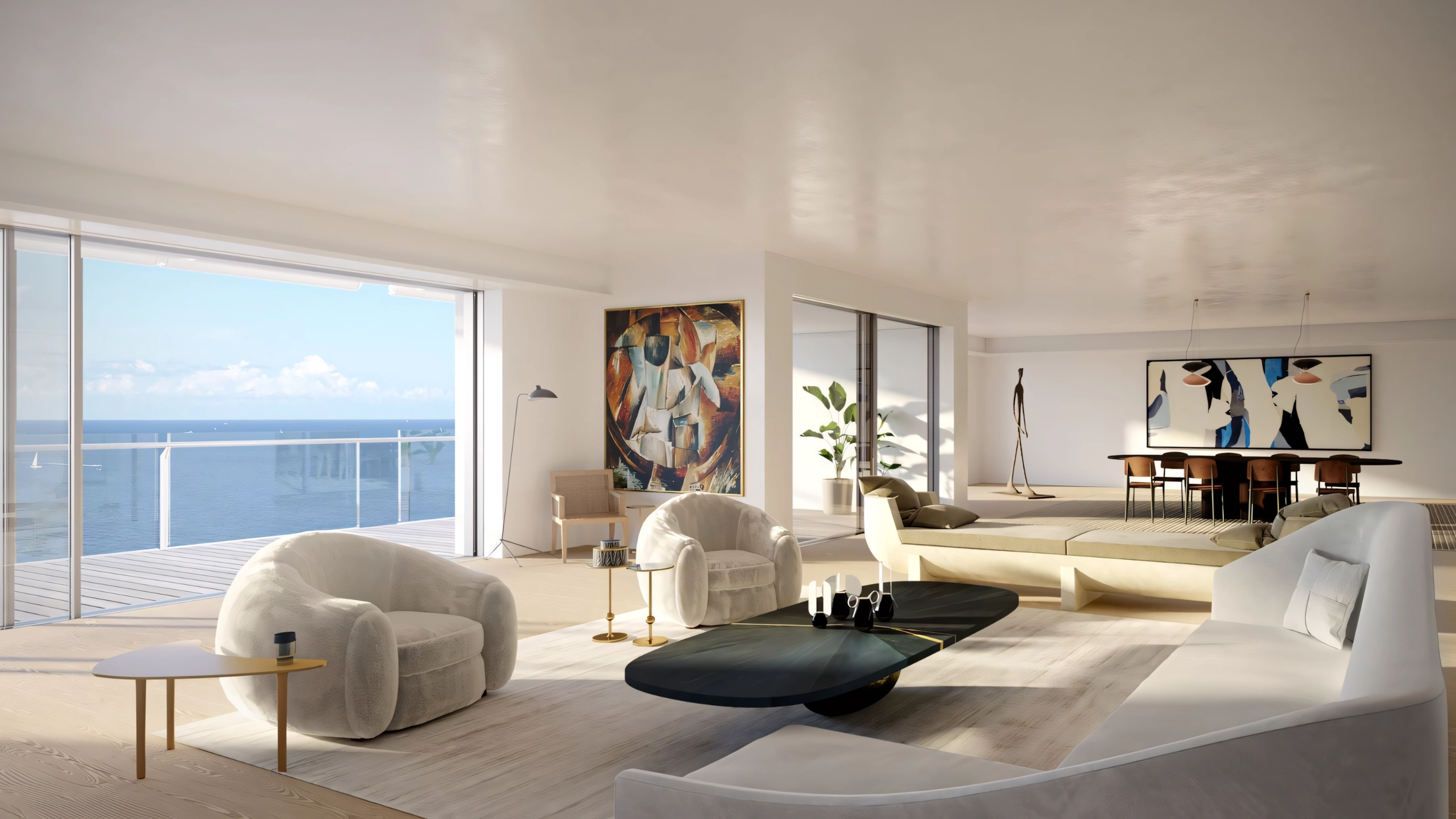
A living room at Le Renzo, part of Mareterra, where several unit types were designed with the uninterrupted wall runs a collection needs.
Buyers who intend to display rather than store should raise floor loading and humidity control with their agent before falling in love with a floor plan. It is a far cheaper conversation to have before signing than after a sculpture arrives at the door.
Buying at a fair or auction is the easy part. Moving a significant work into Monaco, whether from a Paris salesroom, a London gallery or a private sale in New York, involves a customs and insurance process that rewards patience and a competent shipper far more than it rewards speed.
Works entering France or Monaco from outside the EU are generally subject to import VAT and, in some cases, customs duty, unless they move under temporary admission or are routed through a freeport first. Specialist fine art shippers, often the same firms servicing the Monaco Freeport corridor, handle the paperwork, condition reporting and climate-controlled transport that insurers increasingly require as a condition of cover above a modest value threshold. Insurance itself should be arranged before a work leaves the seller’s premises, rather than after it arrives in Monaco; gaps in coverage during transit are where claims most often unravel.
Provenance research deserves the same rigour a buyer would apply to any major asset purchase: title, exhibition history and any prior claims verified independently of the seller’s own paperwork, ideally by an advisor with no commission riding on the sale going through.
The social calendar around Monaco’s art world runs almost entirely through its hotels, and two names recur more than any others.
The Hôtel Hermitage Monte-Carlo hosts Artcurial’s Monaco Auction Week each July, when the auction house’s sculpture, watch, jewellery, comic strip and Hermès departments take over the hotel for a week of exhibitions and sales timed to overlap with the wider fair calendar. Across town, the Hôtel Métropole Monte-Carlo‘s Salon Le Théâtre has become the regular home of Hermitage Fine Art, the Monaco auction house founded in 2017, which stages Russian art, manuscript and jewellery sales there several times a year, typically opening with an invitation-only vernissage for collectors and cultural patrons ahead of the public sale. The Métropole’s own collection, a Picasso, a Warhol and a Bacon now hang in its lobby bar, and its private experience programme arranges after-hours visits to the Francis Bacon MB Art Foundation nearby, the only foundation anywhere dedicated solely to the artist.
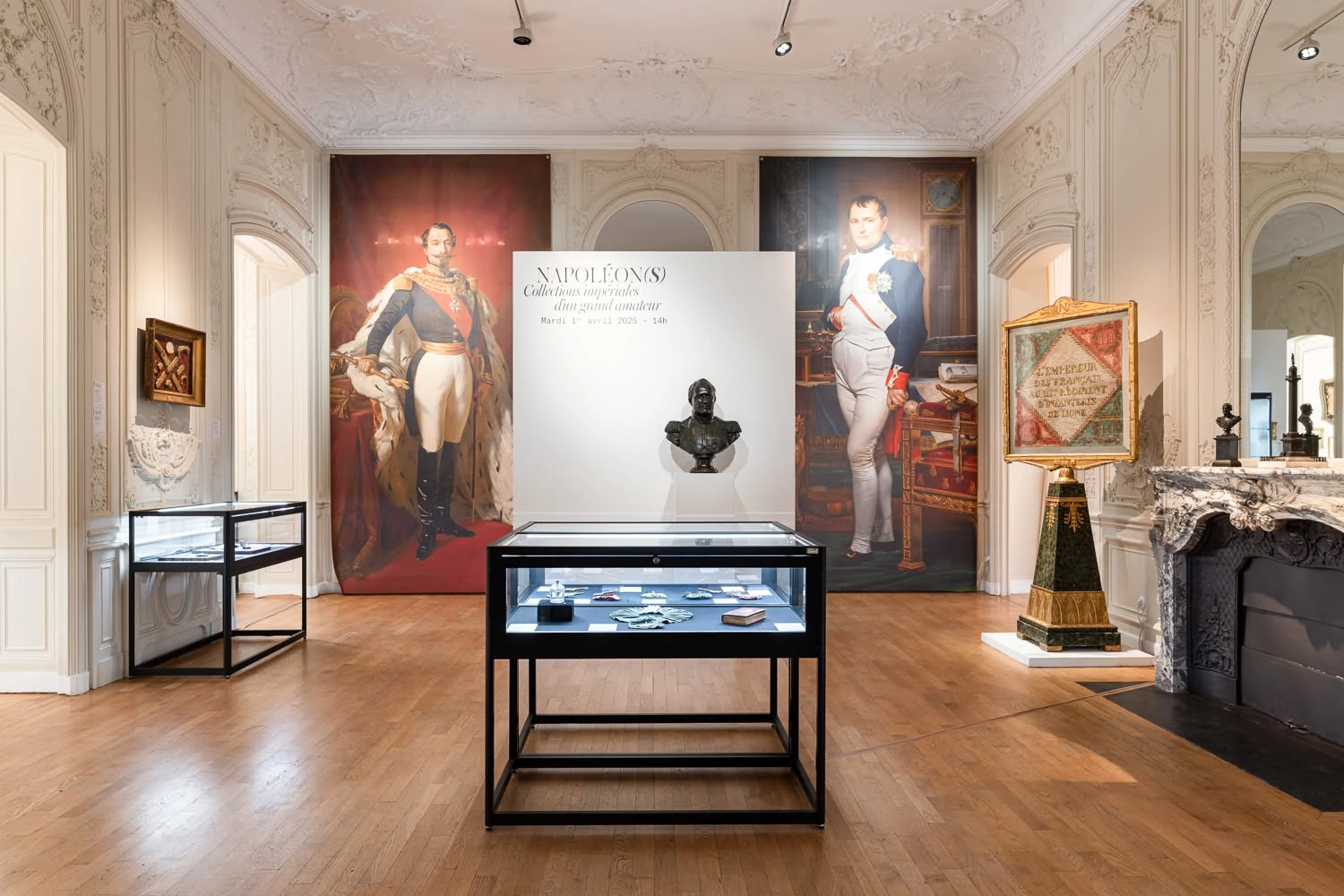
A private showroom during Artcurial’s Monaco Auction Week at the Hôtel Hermitage Monte-Carlo.
Philanthropy threads through most of this. Exhibitions tied to the NMNM and events around artmonte-carlo regularly support environmental and cultural causes under Prince Albert II’s patronage, and the wider Monaco Art Week, timed around fair week, has become the few days each year when the principality’s collectors, dealers and museum directors are reliably in the same rooms.
None of this replaces the advice of a dedicated art adviser, an insurer who understands freeport logistics, or a shipper who has actually moved work through Monaco customs before. What it does is sketch the infrastructure around the art, the part of the market that sits behind the catalogue and the fair booth. Buyers who arrive without a sense of it tend to discover the gaps at the worst possible moment: a work stranded in transit, a floor that cannot bear the weight of what was purchased, or a tax event triggered by a border crossing that a five-minute conversation with a logistics firm would have avoided entirely.
Considering a Monaco property built around a serious art collection, or simply want a floor plan that could accommodate one in future?
Speak with Baldo Realty Group about what the current market allows.
Sources
Art Basel and UBS, Global Art Market Report 2026 | theartmarket.artbasel.com
artmonte-carlo, official fair information | artmontecarlo.ch
Grimaldi Forum Monaco, official events schedule | grimaldiforum.com
Hauser & Wirth, gallery and fair information | hauserwirth.com
Opera Gallery Monaco, official gallery information | operagallery.com
Nouveau Musée National de Monaco, official site | nmnm.mc
Fondation Maeght, official site | fondation-maeght.com
SMT Fine Art, Monaco Freeport information | smt.mc
Galerie Adriano Ribolzi | adrianoribolzi.com
Monte-Carlo Société des Bains de Mer, Artcurial at Hôtel Hermitage Monte-Carlo | montecarlosbm.com
Hermitage Fine Art, auction house information | hermitagefineart.com