Post 8 min read
Monaco covers 208 hectares. That number is worth sitting with. The second-smallest sovereign state on earth has, over more than a century of engineering ambition, extended itself into the Mediterranean through successive land reclamation campaigns. Mareterra, inaugurated in December 2024, added the latest and last six hectares. Monaco’s leaders have stated publicly that further large-scale reclamation is neither possible nor desirable. The boundary of this market is, for all practical purposes, fixed.
For investors evaluating Monaco real estate over a five-year horizon, that constraint is not simply a talking point. It is the foundational variable governing everything from price discovery to liquidity mechanics to holding-period strategy.
Land reclamation has shaped Monaco’s growth for over a century. The early efforts began in the 1880s, with modest extensions in Fontvieille, La Condamine, and La Rousse totalling 5.5 hectares. The Fontvieille industrial and residential district followed in the 1970s, providing critical relief from population pressure on a territory that was then barely 195 hectares. By the time Larvotto was extended between 1954 and 1961, adding 54,000 square metres to Monaco’s eastern coastline, the reclamation model had become the principality’s primary mechanism for managing growth.
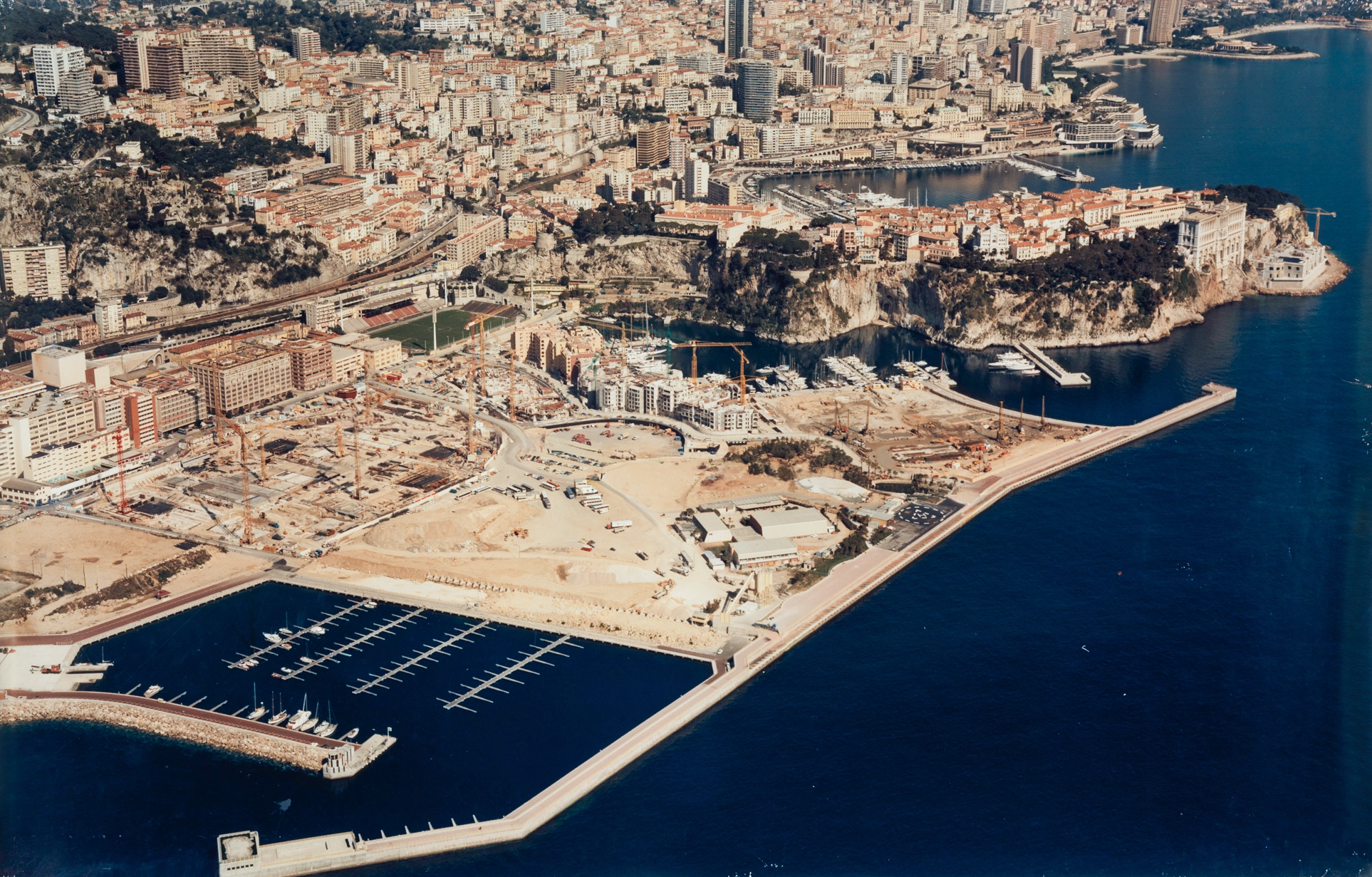
The construction of the Fontvieille land reclamation project in 1982
In total, nearly 60 hectares have been reclaimed from the Mediterranean, now representing around 20% of Monaco’s entire land surface. Mareterra, the eighth and explicitly final major reclamation, required a €2 billion investment, the design leadership of Renzo Piano Building Workshop, Valode et Pistre Architectes, and landscape architect Michel Desvigne, and a concession agreement signed with Monégasque and European investor families in 2015. It generated more than €1.2 billion in VAT and registration fees for the Principality.
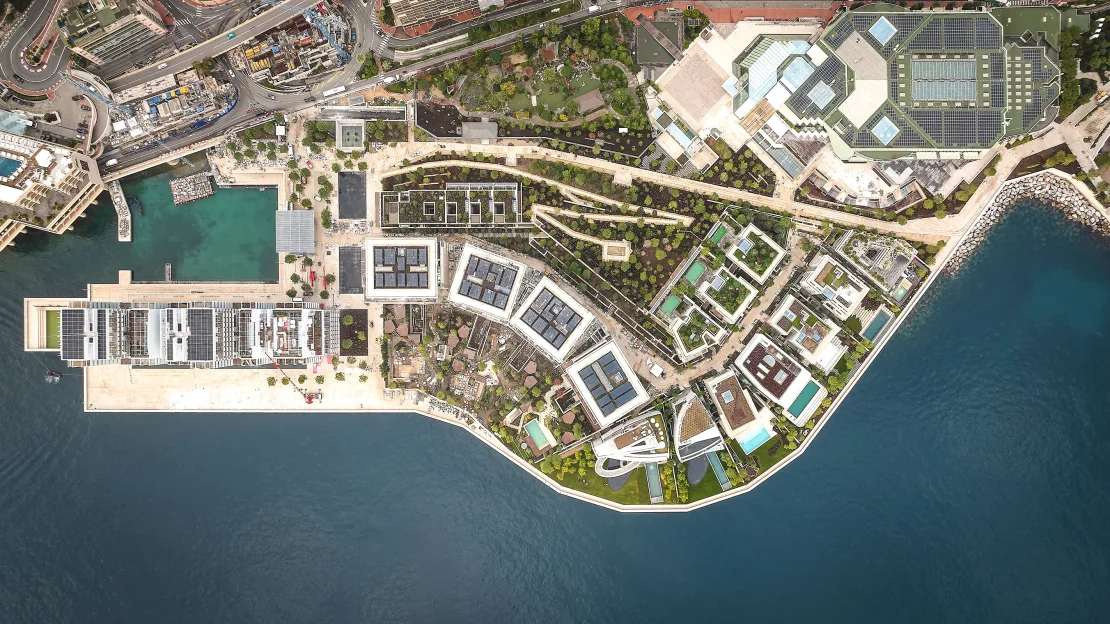
An Aerial View of Mareterra
What Mareterra delivered in residential terms was modest relative to its cost and engineering complexity: 110 apartments, 10 seafront villas, and 4 townhouses. All units were reported sold before the December 2024 inauguration.
The IMSEE Observatoire de l’Immobilier 2025 confirms that 103 new private-sector dwellings were completed across the Principality in 2025, split between La Rousse and Les Moneghetti. The Mareterra units delivered in 2024 totalled 159 completions that year, the highest in the past decade. Over the ten-year period from 2016 to 2025, private-sector new builds totalled 685 units, an average of fewer than 70 per year for a territory of 208 hectares.
Beyond isolated superélévation projects and small residential conversions, no significant new land supply is currently authorised or planned. Redevelopment activity, where existing buildings are demolished and replaced with larger, higher-specification structures, constitutes the real pipeline. The One Monte-Carlo complex and the reconstruction of the Princess Grace Hospital are the clearest recent precedents. This demolish-and-rebuild dynamic is constrained by heritage considerations, neighbour consents, and the practical limits of vertical expansion in a city already built to maximum density in most quartiers.
Monaco’s National Council President Thomas Brezzo has noted the absence of future state revenue from land reclamation of comparable scale. Monaco’s territory, for planning purposes, is effectively closed.
The 2025 IMSEE report, published in February 2026, provides the most granular pricing benchmarks available for the Monaco market. Using a linear regression model integrating transaction year, neighbourhood, and construction period, the report estimates the average price per square metre across all transactions at €57,569 in 2025.
At neighbourhood level, the dispersion is significant:
The Larvotto premium is directly tied to Mareterra. With 13 resale transactions recorded in the quartier in 2025, at a total value of €851.9 million, the district produced the highest resale value in Monaco despite registering the lowest transaction volume of any neighbourhood. The average implied transaction in Larvotto approached €65 million. This is what happens when new ultra-prime stock enters the resale market in a liquidity-constrained environment.
For recently built stock across the entire Principality (construction period 2020–2029), estimated prices per square metre in 2025 ranged from €47,800 in Jardin Exotique to €71,241 in Larvotto, with Monte-Carlo new builds at €60,526 and La Condamine at €59,523. Every neighbourhood posted year-on-year gains for this cohort.
The ten-year data table from IMSEE (2016–2025) shows sustained appreciation across all neighbourhoods, with no sustained retreat in any quartier over the full period. Larvotto appreciated from €55,234/m² in 2016 to €71,167/m² in 2025, a gain of approximately 29% over nine years. Monte-Carlo moved from €43,343/m² to €54,009/m², a rise of around 25%. Les Moneghetti, the most accessible entry point in the Principality, grew from €33,686/m² to €43,797/m², up roughly 30%.
These gains occurred across a period that included the Covid-19 disruptions of 2020, during which total transaction volume fell to 411, the lowest in the dataset. Prices held and recovered. The structural compression between demand and supply absorbed what would have been a severe pricing correction in a more liquid, expandable market.
In 2025, the Monaco market recorded 493 total transactions, up 5.8% from 2024. Total transaction value was €5.9 billion, broadly in line with the record prior year. Resales drove the gain: 429 resale transactions at a total value of €3.2 billion, a new record and a 49.1% increase in value year-on-year.
The resale market is where supply constraint produces its clearest effects. With only 685 new units delivered over a decade, the overwhelming majority of transactions involve existing stock changing hands. The resale market is the Monaco market. Holding is the dominant strategy because the replacement cost of a sold unit, in a constrained supply environment, is structurally higher than the exit price.
Total residential housing space across the Principality stood at approximately 2.03 million square metres as of 31 December 2025, distributed across 1,473 buildings. More than 40% of residential floor space is concentrated in Monte-Carlo and La Rousse. The absolute ceiling on this figure is visible: short of demolish-and-rebuild projects, no material addition to the denominator is possible.
Monaco’s approach to future territorial expansion has become explicit. Following Mareterra, the Principality has signalled that further reclamation must meet standards that make large-scale projects practically unachievable in the near term. The environmental sensitivity of the Larvotto marine reserve, created in 1976 specifically to compensate for prior coastal extension, places a hard constraint on eastern expansion. Western and northern boundaries are French territory. There is no undeveloped coastal frontier left.
Redevelopment, the only remaining supply mechanism, is subject to planning rules administered by the Direction de la Prospective, de l’Urbanisme et de la Mobilité. Monaco’s 2013 ordinance establishing seven administrative quartiers with defined building envelopes limits the scale of vertical expansion. Superélévation projects, the addition of floors to existing buildings, require both regulatory approval and the consent of existing co-owners, conditions that slow delivery materially.
The constraint profile Monaco presents is instructive when placed alongside other supply-limited prime markets. In prime central London, a large and theoretically developable urban zone, the constraint on prime supply is partly political and partly planning-related, but the land itself is not finite in any meaningful sense. Hong Kong’s developable land is constrained by topography and by political choices about the New Territories. Singapore has pursued aggressive reclamation to expand from 581 km² at independence to approximately 734 km² today, a flexibility Monaco structurally cannot replicate.
What Monaco shares with the most constrained segments of these markets, specifically the Peak in Hong Kong, the Bishops Avenue corridor in London, or the Sentosa Cove district in Singapore, is the combination of fixed supply with a global buyer pool that is not meaningfully price-sensitive. The difference is that Monaco’s fixed supply applies to the entire jurisdiction, not just one neighbourhood within it.
Knight Frank’s global prime residential index has consistently ranked Monaco among the three most expensive residential markets globally on a per-square-metre basis. The fundamentals supporting that position are structural rather than cyclical.
In the absence of net new supply, the market upgrades itself through renovation and demolish-rebuild cycles. Buildings completed in the 2020–2029 cohort command a measurable premium over older stock in every neighbourhood, as the IMSEE price-by-construction-period data confirms. This bifurcation matters for investors.
Properties in need of significant renovation carry lower entry prices but require investors to navigate Monaco’s complex co-ownership laws and building permit processes. Full-floor or full-building acquisitions, common among UHNW buyers who prefer to control renovation scope entirely, represent a distinct sub-market. The demolish-and-rebuild route, as seen with villa acquisitions, produces the highest-specification outcomes but involves holding periods of five years or more before the rebuilt asset can be liquidated at optimal pricing.
For buyers entering the market with a five-year horizon, the data supports several observations worth noting without constituting investment advice:
Investors evaluating available properties in Monaco should treat this supply context as the primary framework for pricing analysis, rather than relying on historical transaction averages alone.
Monaco imposes no capital gains tax on real estate for most buyers. The absence of this friction on exit is a meaningful structural advantage compared to Paris, London, or Geneva, where a decade-long hold triggers substantial tax events. This asymmetry between income jurisdictions and Monaco has historically supported longer average holding periods among Monaco owners, which in turn deepens the structural supply constraint by reducing voluntary listings.
The implication is circular and reinforcing: low supply encourages holding, which reduces supply further, which supports price appreciation, which encourages holding. Breaking this cycle typically requires fiscal pressure or forced sales, neither of which characterises the Monaco owner profile at scale.
To discuss the current inventory landscape and how supply dynamics affect specific acquisition strategies, the team at Baldo Realty Group is available for a confidential consultation.
This article is for informational purposes only and does not constitute financial, legal, or investment advice. Real estate investment involves risk and individual circumstances vary. Readers should seek independent professional guidance before making any property-related decisions.