Post 11 min read
Anyone in a position to consider Monaco as a residence is also in a position to be at the Cleveland Clinic in Ohio or the Charité in Berlin inside a day, two of the handful of hospitals patients cross continents to reach. Private aviation solves the planned problem well: the second opinion, the named surgeon, the procedure four hospitals in the world perform properly. It does nothing for the unplanned problem at three in the morning, and nothing at all for the decade of routine follow-up that arrives after a serious diagnosis. Those are questions of proximity, and proximity is the one medical variable that a change of address genuinely moves.
So the useful questions about healthcare in Monaco are narrower than the ones a relocation brochure answers. What can be reached in fifteen minutes on a bad night, what has to leave the country and how far it goes when it does, and what a state of forty thousand people manages to do unusually well. The answers run in both directions, which is why they are worth setting out properly.
The Centre Hospitalier Princesse Grace is the Principality’s only public hospital. It opened in 1902 as the Hôpital Prince Albert and took Grace Kelly’s name in 1958, and it now runs to some 845 beds across three sites in the Jardin Exotique quarter on the western side of the country. Twenty-one specialties are practised there. The technical platform is better than the building’s age suggests: a 3 Tesla MRI, a PET scanner, a Novalis TrueBeam radiotherapy accelerator, and a Da Vinci surgical robot in use since 2012 across urological, gastrointestinal and gynaecological work, an activity that has earned the hospital a European centre of excellence label.
Oncology, cardiology and geriatrics are named as priority specialties, and the third of those is the one worth pausing on. Geriatric medicine here is not a department bolted onto a general hospital. The Rainier III clinical gerontology centre sits inside the CHPG, and the hospital also runs the Cap Fleuri and A Qietüdine residences as part of the same organisation. For a family whose calculations extend to a parent’s last fifteen years rather than their own next five, that structure matters more than any piece of imaging equipment.
The catchment is larger than the country. The CHPG serves Monaco and the neighbouring French communes, which is how a population under forty thousand supports a hospital of that size at all. It is worth understanding this before reading anything else about Monégasque healthcare: the Principality’s medical system is not sized to its own borders, in either direction.
Sitting alongside the public hospital, and largely unknown to residents who have not needed it, is the Centre Cardio-Thoracique de Monaco. Founded in 1987 by Professor Vincent Dor and dedicated exclusively to cardiac and thoracic medicine, it occupies twelve levels on avenue d’Ostende with 72 beds and 15 intensive care beds. It is a private institution that contributes formally to the Principality’s public healthcare service, which is an arrangement with few equivalents anywhere.
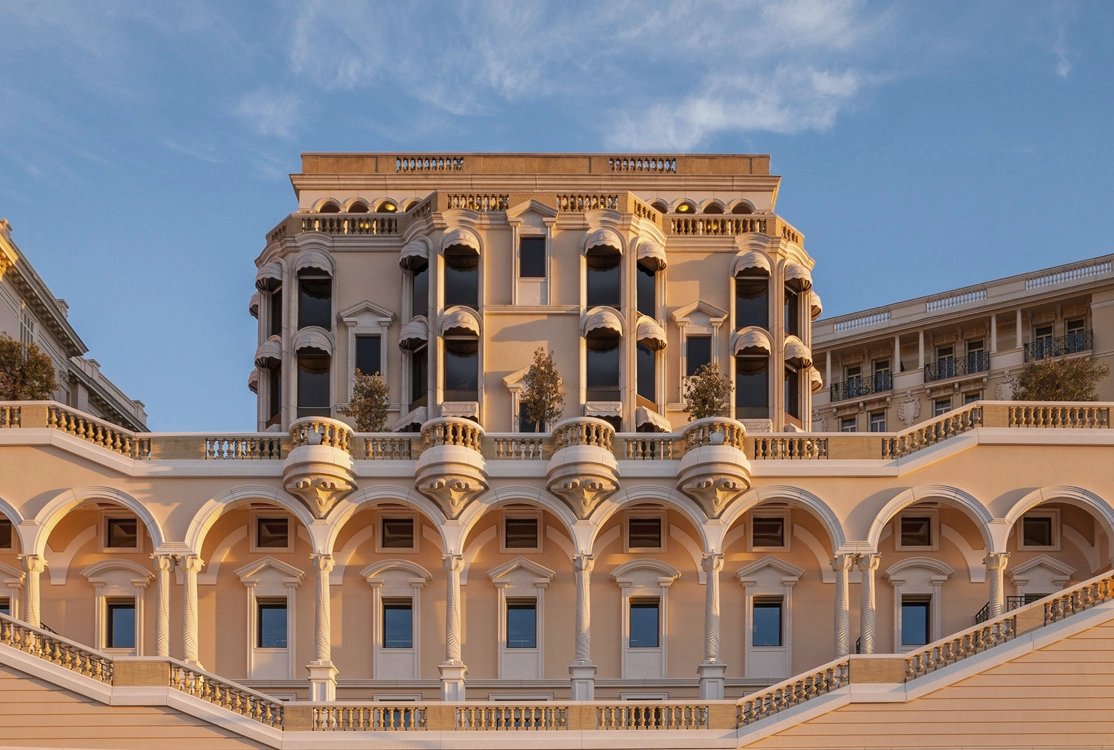
The Centre Cardio-Thoracique on avenue d’Ostende: twelve levels given over entirely to cardiac and thoracic medicine, with every room facing either the harbour or the Rock.
Its details give away who it was built for, and this is where the case for Monaco stops being about hospitals and starts being about how a particular kind of household actually lives. Every room faces either the harbour or the Rock, and any of them converts into a suite so that a family member can stay on the ward rather than in a hotel. The centre keeps Arabic, Russian, Italian and English speakers on staff. It collects patients from Nice airport or the Monaco heliport, assists with medical Schengen visas for those who need them, and holds direct access to the Hôtel Hermitage next door for relatives who want to be close without occupying a bed. None of that is incidental. It is a serious cardiac hospital designed around the way its patients travel.
The Institut Monégasque de Médecine et Chirurgie du Sport covers orthopaedics and sports medicine and has done since 2006, with more than forty practitioners across joint replacement, spine, hand and shoulder surgery, and a trauma unit staffed around the clock. The division of labour is real rather than nominal: the CHPG transferred its orthopaedic surgical activity to the IM2S, so the specialist institution is where that work is actually done.
Two private institutions of genuine specialist depth, inside a country a reasonably fit person can cross on foot, both organised around patients who arrive by air. That combination is the part of the Monaco proposition that is difficult to replicate, and it is almost never the part that features in the brochure.
Every small system has a limit, and the honest thing is to say where Monaco’s sits. Stroke is the clearest case, and the most uncomfortable one, because it is precisely the emergency the proximity argument is built around. The CHPG is not currently equipped to manage the full range of stroke presentations. A government study is reported to have identified 174 stroke cases in Monaco in 2023, of which eighteen went straight to the CHU de Nice at Hôpital Pasteur 2, and a further nine were taken in at the CHPG before being transferred on. A dedicated neurology unit arrives with the new building, targeted at 2027, and the planning for it was still being described as early stage as recently as last winter. Closing that gap is one of the stated aims of the rebuild: the new hospital is designed to treat a wider range of medical emergencies inside the Principality, stroke among them, so that fewer time-critical cases have to travel at all.
When a transfer happens, the mechanism is already in place. Monaco’s healthcare arrangements with France give residents formal access to French university hospitals, with Nice’s the nearest and the most used. Pasteur 2 is roughly half an hour away by road in ordinary traffic, and no family has to arrange any of it themselves. The reach of Monégasque medicine extends well past the Principality’s borders, which is the reason a country this size can offer what it does.
What decides it for most households is the eight-minute question on a bad night, and whether the same consultant is still in post six years later. Both of those favour Monaco, and neither of them is the same as having every specialty on the doorstep. For the large majority of what a household encounters over twenty years, the Principality is close enough and continuous enough. For a narrow band of time-critical neurological work, the relevant hospital is currently in France, and will be until the new unit opens. Knowing which category a condition falls into is worth more than any general reassurance about standards.
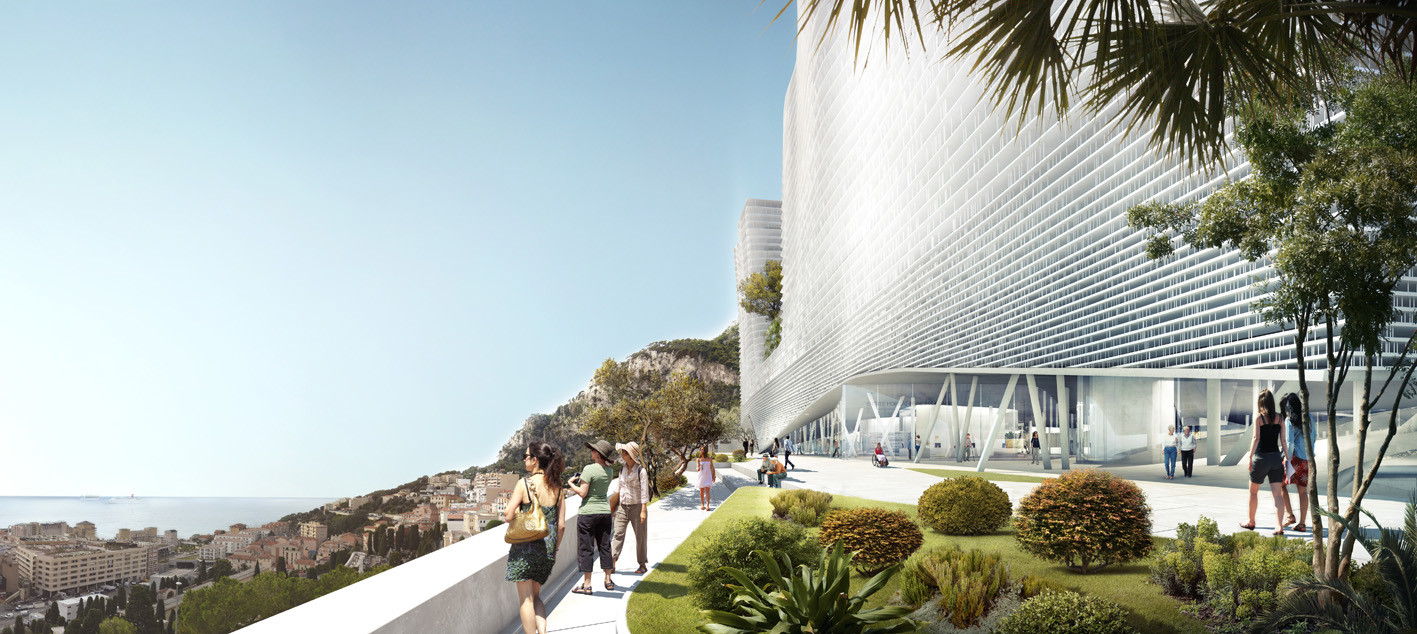
In July 2026, after ten years of construction, the keys to a new hospital building passed from the people who built it to the people who will run it, at a ceremony attended by Prince Albert II. The 40,000 square metres they took possession of are the first phase of a scheme reaching 107,000 square metres and 458 beds and day places on completion. The specification is closer to a teaching hospital serving a mid-sized city than to a principality’s general infirmary: fifteen intervention rooms including a hybrid suite, two interventional cardiology rooms, a twenty-two-place ambulatory surgery unit connected directly to the theatres, an emergency scanner on site, a molecular biology platform, and the neurology unit the Principality has never had. Taken together, that is a hospital built to keep emergencies the current one has to send away.
The accommodation shows who the project expects to treat. Eighty-five percent of rooms are single from this first phase onward, each accommodation unit carries a premium suite of 36 square metres across a bedroom and a sitting room, and the top floor holds an assessment unit with five suites of 59 square metres. There is a walk along the front looking toward the Rock, a restaurant open to the public and a play area for children, on the reasonable theory that a hospital people are willing to enter is a hospital people use earlier.
Handing over keys is not the same as opening doors, and this distinction is the one that matters to anyone moving this year. The building now enters dry-run and safety certification running to the end of 2026, first patients are expected in early 2027, and services migrate in stages. Full completion is scheduled for 2032, with the most recent official commentary already pointing past that date. A family relocating now will be treated in the existing hospital for some time yet.
The cost has been examined at home rather than glossed over, which is to the Principality’s credit. Monaco’s Commission Supérieure des Comptes has tracked the project across successive budgets and reported in the spring of 2026 that an operation first costed at €586 million had reached €1.3 billion, a gap of €714 million, more than half of it attributed to price revisions across the length of the works. Set against a resident population of roughly 38,900, that is a little over €33,000 a head. The hospital’s operating position has drawn attention alongside the capital cost, with a deficit in the order of €60 million debated during the 2025 rectifying budget. What the overrun mostly reflects is the difficulty of rebuilding on a constrained site that had to keep treating patients throughout.
The most accessible preventive provision is inside the Principality. Thermes Marins Monte-Carlo, run by Société des Bains de Mer on avenue de Monte-Carlo, gives 6,600 square metres over to wellness, fitness and preventive health, with programmes organised around quality ageing and performance and a staff that includes a doctor, a nutritionist, physiotherapists and coaches. Some examinations are run in partnership with the Principality’s health establishments. The house describes its own approach as preventive rather than therapeutic, and that self-description is more accurate than most of what the sector says about itself.
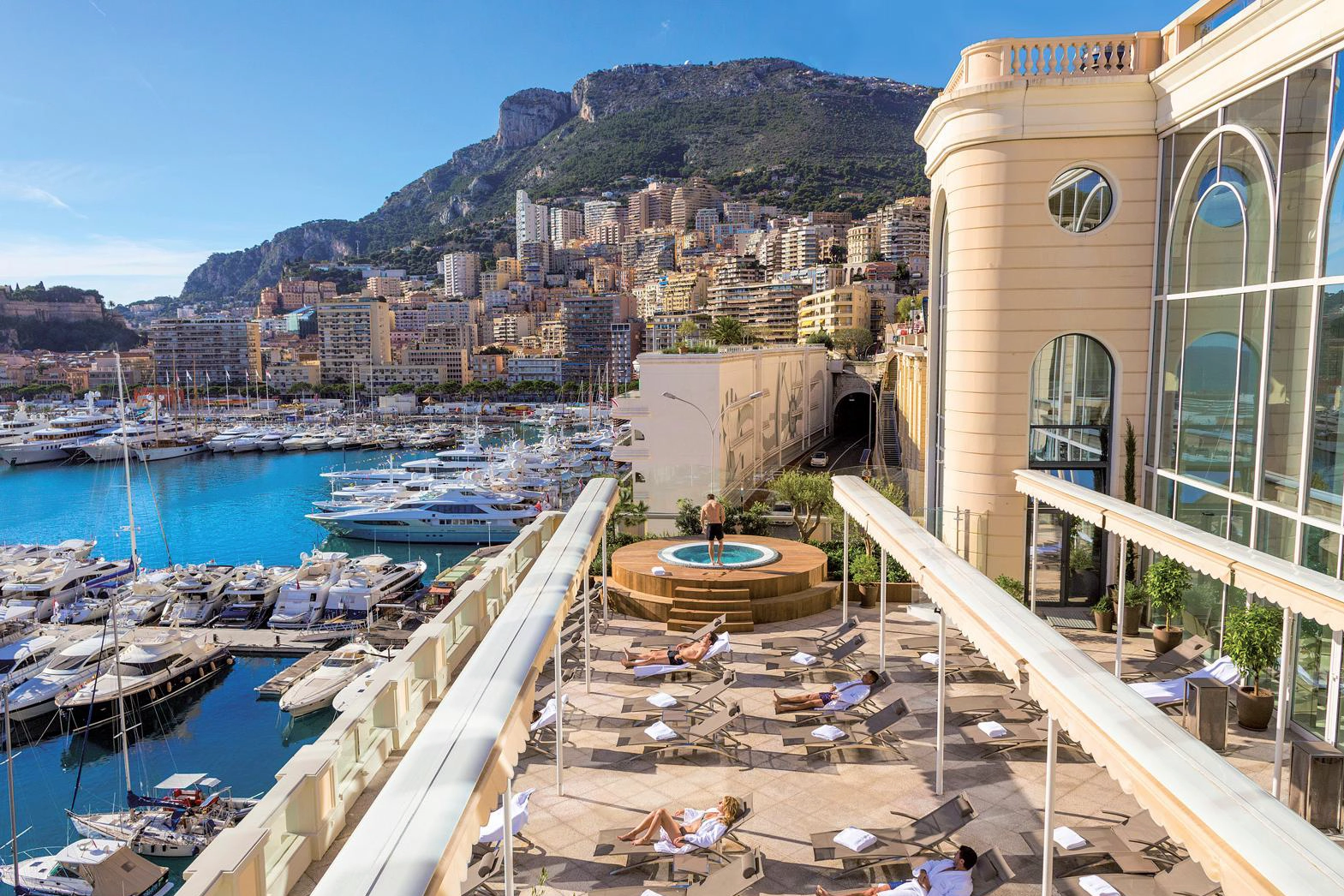
Thermes Marins Monte-Carlo: 6,600 square metres of preventive health above the Mediterranean, and the most accessible provision of its kind inside the Principality.
The wider coast has a genuine cluster, though the geography is usually left vague in the marketing. Nice and Cannes hold the nearest concentration of regenerative and aesthetic practice, both within an easy drive. The residential longevity programmes are further out: the Spa Nescens at La Réserve Ramatuelle runs multi-day Better-Aging protocols under Clinique Nescens medical supervision, and Lily of the Valley nearby has organised its entire proposition around longevity, detox and sports performance, but both sit near Saint-Tropez, which is a two-hour drive rather than a local option. Worth the journey for a residential week, irrelevant to a Tuesday appointment.
The field has matured enough locally to sustain its own calendar, with Monaco and Nice having hosted the Hololife Longevity Côte d’Azur Summit, the coast’s first substantial gathering of longevity researchers and practitioners. A distinction is worth holding onto through all of it. Preventive medicine with an evidence base, meaning screening, cardiovascular risk management, structured nutrition and movement, is a different product from the longevity market, which sells certainty it does not yet possess and prices it with more confidence than the data supports. A family that keeps the two apart will get considerably better value from both.
Monaco requires every resident to hold valid health cover. Employees fall under the Caisse de Compensation des Services Sociaux, the self-employed under the Caisse d’Assurance Maladie des Travailleurs Indépendants, and those who fit neither must carry a recognised private policy in place of a state scheme. Most families layer private complementary cover on top regardless of which base applies, and for this readership that layer is usually doing the real work, since it governs access to the private specialist institutions and to accommodation of the kind the Centre Cardio-Thoracique offers.
The sequencing catches new arrivals out. The residence card produced by the residency process is generally the document that unlocks healthcare registration, so the two cannot be run in parallel as freely as people expect, and a family that assumes otherwise can spend its first weeks in the Principality uninsured on paper while entirely insurable in fact.
Proximity to the CHPG and to a trusted general practitioner counts for more across a decade than it does in the enthusiasm of a first purchase, and the geography is specific rather than general. The hospital sits in the Jardin Exotique quarter on the western side of the country, which means the drive time from Larvotto is not the drive time from Fontvieille. In a state this small the difference is measured in minutes rather than hours, but minutes are the unit the entire argument is denominated in.
Families thinking about where to establish a long-term base increasingly select for lift access, on-site staff and single-level layouts, and they do it earlier than they used to. Monaco’s better-serviced residences get chosen on those grounds as often as for the view, particularly by buyers who have already watched a parent’s generation manage the alternative in a house with stairs and no concierge.
None of this is medical advice, and coverage turns on employment status and personal circumstance in ways only a licensed adviser and Monaco’s own social security administration can resolve for a specific family. Anyone planning a move should establish which scheme applies, whether complementary cover is necessary or merely sensible, and what the residency route itself demands, well before the removal vans are booked.
Monaco’s medical case rests on proximity and continuity rather than on any single institution: a public hospital serving a catchment larger than the country, two private specialist centres organised around internationally mobile patients, and formal access to French university hospitals for what the Principality does not yet cover. A €1.3 billion rebuild takes its first patients in early 2027 and widens what can be treated on site, stroke included, before completing in 2032. The limits are worth knowing as precisely as the strengths.
Families weighing healthcare and long-term continuity as part of a move to the Principality are welcome to contact Baldo Realty Group for a confidential conversation about which districts and buildings suit their circumstances.
Sources
Centre Hospitalier Princesse Grace, official site
Government of Monaco, handover of the new hospital building
L’Observateur de Monaco, inside the new hospital
Monaco Hebdo, stroke care and the planned neurology unit
Monaco Hebdo, audit of the project costs
Centre Cardio-Thoracique de Monaco
Thermes Marins Monte-Carlo, Société des Bains de Mer
CLEISS, healthcare cooperation between France and Monaco
Monaco government, health insurance funds